球 (qiú) means "Ball" in Chinese. It has 11 strokes with the radical 王, and is HSK Level 1.
Rated 3.7/5 in difficulty (challenging).
Harder than 92% of HSK Level 1 characters.
Appears in 3+ common words including 足球 (zú qiú), 篮球 (lán qiú), 地球 (dì qiú).
Due to its 11 strokes, Hanzi Writer's error detection shows 球 requires focused practice — most learners need 10+ attempts for consistent accuracy.
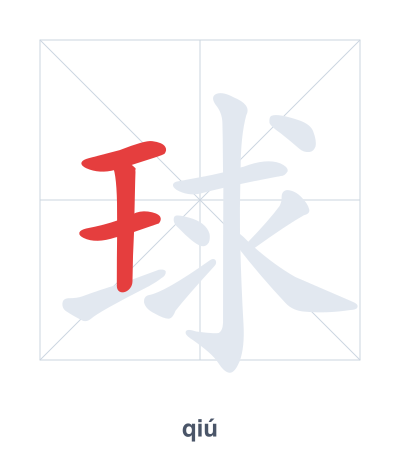
Open Hanzi Writer to see the animated stroke order and practice writing 球 with real-time feedback.
The character 球 (qiú) is written with 11 strokes. Follow the standard Chinese stroke order: top to bottom, left to right, outside before inside. The radical 王 is one of its key components.
Practice the correct stroke order with the Hanzi Writer app to see animated stroke-by-stroke guidance with real-time feedback.
球 means Ball.
As an HSK Level 1 character, 球 is among the first characters beginners learn.
球 combines the radical 王 (jade, short for 玉) with 求 (qiú), which gives the sound. Originally it referred to a beautiful jade or a ball-shaped gem, later extended to mean any ball-shaped object.
💡 Memory Tip: Picture a king (王) asking (求) for a ball to play with.
我踢足球。
wǒ tī zú qiú
I play soccer.
他打篮球。
tā dǎ lán qiú
He plays basketball.
地球很大。
dì qiú hěn dà
The Earth is very large.
Open Hanzi Writer to see the animated stroke order and practice writing 球 with real-time feedback.
✨ Animated stroke order · Handwriting recognition · HSK-graded practice · Free to use
球 is made of two parts: the radical 王 (jade/king) on the left and the phonetic component 求 on the right. Originally, 球 referred to a type of fine jade, but the meaning shifted to 'ball' because both jade and balls can be round objects. Today the 王 radical hints at the idea of a precious or refined object, while 求 provides the pronunciation qiú.