姥 (lǎo) means "Maternal grandmother" in Chinese. It has 9 strokes with the radical 女, and is HSK Level 7.
Rated 4/5 in difficulty (challenging).
Harder than 39% of HSK Level 7 characters.
Appears in 3+ common words including 姥姥 (lǎo lao), 姥爷 (lǎo yé), 姥家 (lǎo jiā).
Due to its 9 strokes, Hanzi Writer's error detection shows 姥 requires focused practice — most learners need 10+ attempts for consistent accuracy.
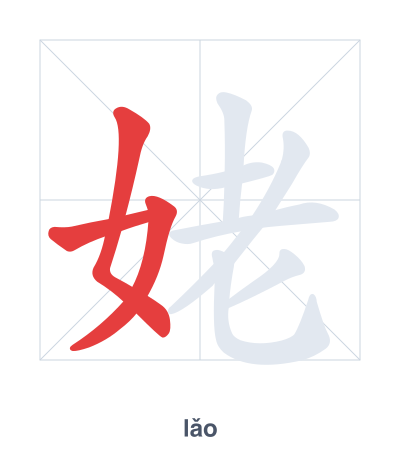
Open Hanzi Writer to see the animated stroke order and practice writing 姥 with real-time feedback.
The character 姥 (lǎo) is written with 9 strokes. Follow the standard Chinese stroke order: top to bottom, left to right, outside before inside. The radical 女 is one of its key components.
Practice the correct stroke order with the Hanzi Writer app to see animated stroke-by-stroke guidance with real-time feedback.
姥 means Maternal grandmother.
As an HSK Level 7 character, 姥 is an intermediate-level character.
姥 is a compound character combining the radical 女 (woman) on the left and 老 (old) on the right, indicating an old woman. In ancient usage it specifically denoted one's maternal grandmother, as the 'old woman' of the mother's side.
💡 Memory Tip: Picture your maternal grandmother as an old woman (老) who always tells you stories while knitting, with the 女 radical reminding you she's female.
姥姥住在北京。
lǎo lao zhù zài běi jīng
Grandma lives in Beijing.
姥爷喜欢下棋。
lǎo yé xǐ huān xià qí
Grandpa likes playing chess.
明天我回姥家。
míng tiān wǒ huí lǎo jiā
I am going back to my maternal grandmother's house tomorrow.
Open Hanzi Writer to see the animated stroke order and practice writing 姥 with real-time feedback.
✨ Animated stroke order · Handwriting recognition · HSK-graded practice · Free to use
姥 is composed of the radical 女 (meaning woman) on the left, and 老 (meaning old) on the right. Together they suggest "old woman," which refers to a maternal grandmother. This structure directly links the idea of an elderly female relative.