爷 (yé) means "Grandfather" in Chinese. It has 6 strokes with the radical 父, and is HSK Level 1.
Rated 2.7/5 in difficulty (moderate).
Harder than 47% of HSK Level 1 characters.
Appears in 3+ common words including 爷爷 (yé yé), 老爷 (lǎo yé), 大爷 (dà yé).
Hanzi Writer's stroke validation shows learners typically need 5-8 attempts to write 爷 with correct proportion and order.
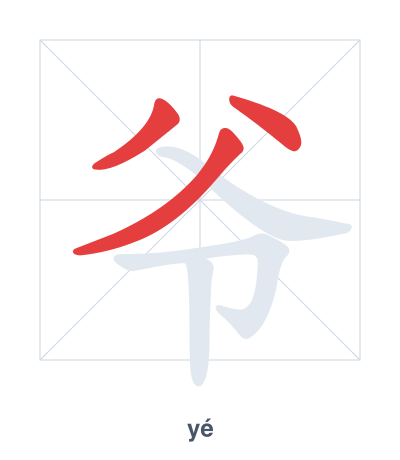
Open Hanzi Writer to see the animated stroke order and practice writing 爷 with real-time feedback.
The character 爷 (yé) is written with 6 strokes. Follow the standard Chinese stroke order: top to bottom, left to right, outside before inside. The radical 父 is one of its key components.
Practice the correct stroke order with the Hanzi Writer app to see animated stroke-by-stroke guidance with real-time feedback.
爷 means Grandfather.
As an HSK Level 1 character, 爷 is among the first characters beginners learn.
爷 is a simplified compound character. The top part 父 means 'father,' and the bottom part was originally the phonetic component 耶 (now simplified to a bent line). Together, in traditional usage, it represented the father’s father—the grandfather.
💡 Memory Tip: Picture a father (父) using a curved walking stick (the bottom stroke) as he becomes an old grandfather.
爷爷在喝茶。
yé yé zài hē chá
Grandpa is drinking tea.
姥爷很有钱。
lǎo yé hěn yǒu qián
Grandpa is very rich.
大爷,您去哪儿?
dà yé nín qù nǎ ér
Sir, where are you going?
Open Hanzi Writer to see the animated stroke order and practice writing 爷 with real-time feedback.
✨ Animated stroke order · Handwriting recognition · HSK-graded practice · Free to use
The character 爷 is made of the radical 父 (father) on top and a simplified bottom part. The top shows it relates to male family members, and the bottom part originally indicated an elder, together meaning 'grandfather'.