垃 (lā) means "trash (used in 垃圾)" in Chinese. It has 8 strokes with the radical 土, and is HSK Level 4.
Rated 3.7/5 in difficulty (challenging).
Harder than 41% of HSK Level 4 characters.
Appears in 3+ common words including 垃圾 (lā jī), 垃圾桶 (lā jī tǒng), 垃圾袋 (lā jī dài).
Due to its 8 strokes, Hanzi Writer's error detection shows 垃 requires focused practice — most learners need 10+ attempts for consistent accuracy.
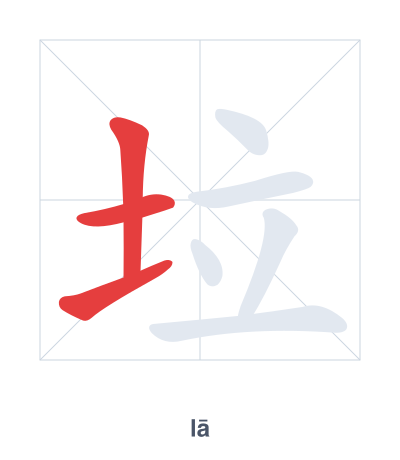
Open Hanzi Writer to see the animated stroke order and practice writing 垃 with real-time feedback.
The character 垃 (lā) is written with 8 strokes. Follow the standard Chinese stroke order: top to bottom, left to right, outside before inside. The radical 土 is one of its key components.
Practice the correct stroke order with the Hanzi Writer app to see animated stroke-by-stroke guidance with real-time feedback.
垃 means trash (used in 垃圾).
As an HSK Level 4 character, 垃 is an intermediate-level character.
垃 is a compound character with the radical 土 (earth/dirt) and the phonetic component 立 (standing). It originally depicted a pile of dirt or trash, emphasizing the concept of waste accumulating on the ground.
💡 Memory Tip: Imagine a heap of trash (土) standing upright (立) like a dirty little mountain.
请不要乱扔垃圾。
qǐng bú yào luàn rēng lā jī
Please don't litter.
垃圾桶在门后面。
lā jī tǒng zài mén hòu miàn
The trash can is behind the door.
我需要买一些垃圾袋。
wǒ xū yào mǎi yī xiē lā jī dài
I need to buy some trash bags.
Open Hanzi Writer to see the animated stroke order and practice writing 垃 with real-time feedback.
✨ Animated stroke order · Handwriting recognition · HSK-graded practice · Free to use
The character 垃 is composed of two parts: the radical 土 (earth, dirt) on the left and 立 (stand) on the right. The 土 radical connects to garbage because trash is often associated with dirt or ground, while 立 mainly provides the pronunciation lā. So the character suggests "something dirty on the ground" rather than having a direct etymological link to trash.