棵 (kē) means "Measure word for trees or plants" in Chinese. It has 12 strokes with the radical 木, and is HSK Level 4.
Rated 4.2/5 in difficulty (advanced).
Harder than 75% of HSK Level 4 characters.
Appears in 3+ common words including 一棵树 (yī kē shù), 几棵草 (jǐ kē cǎo), 这棵菜 (zhè kē cài).
Due to its 12 strokes, Hanzi Writer's error detection shows 棵 requires focused practice — most learners need 10+ attempts for consistent accuracy.
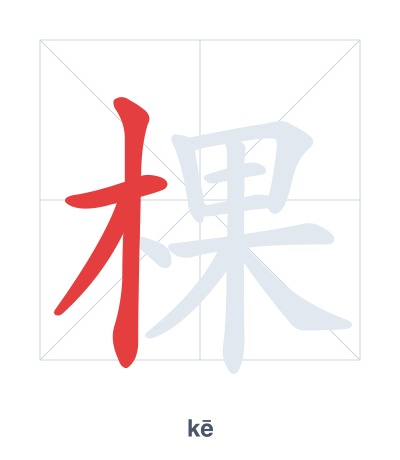
Open Hanzi Writer to see the animated stroke order and practice writing 棵 with real-time feedback.
The character 棵 (kē) is written with 12 strokes. Follow the standard Chinese stroke order: top to bottom, left to right, outside before inside. The radical 木 is one of its key components.
Practice the correct stroke order with the Hanzi Writer app to see animated stroke-by-stroke guidance with real-time feedback.
棵 means Measure word for trees or plants.
As an HSK Level 4 character, 棵 is an intermediate-level character.
棵 is a phono-semantic compound. The radical 木 (tree) indicates its connection to plants, while the component 果 (fruit, pronounced guǒ) provides the sound and also suggests a tree bearing fruit, making it a natural unit for counting trees.
💡 Memory Tip: Picture a fruit tree (木 + 果) where each piece of fruit marks one individual tree, so '一棵树' means 'one tree'.
我家门前种着一棵树,夏天可以遮阳。
wǒ jiā mén qián zhǒng zhe yī kē shù , xià tiān kě yǐ zhē yáng 。
There is a tree planted in front of my house, which provides shade in the summer.
花园里的角落里长出了几棵草。
huā yuán lǐ de jiǎo luò lǐ zhǎng chū le jǐ kē cǎo 。
A few blades of grass have grown in the corner of the garden.
这棵菜很新鲜。
zhè kē cài hěn xīn xiān
This vegetable is very fresh.
Open Hanzi Writer to see the animated stroke order and practice writing 棵 with real-time feedback.
✨ Animated stroke order · Handwriting recognition · HSK-graded practice · Free to use
棵 is composed of the radical 木 (tree) on the left and the character 果 (fruit) on the right. The left radical shows it relates to trees and plants, while 果 hints at the pronunciation and reminds us of fruit-bearing trees. Together, this structure tells you that 棵 is a measure word for trees and plants.