獗 (jué) means "Rampant; unrestrained" in Chinese. It has 15 strokes with the radical 犭.
Rated 4.2/5 in difficulty (advanced).
Appears in 3+ common words including 猖獗 (chāng jué), 猖獗一时 (chāng jué yī shí), 猖獗无度 (chāng jué wú dù).
Due to its 15 strokes, Hanzi Writer's error detection shows 獗 requires focused practice — most learners need 10+ attempts for consistent accuracy.
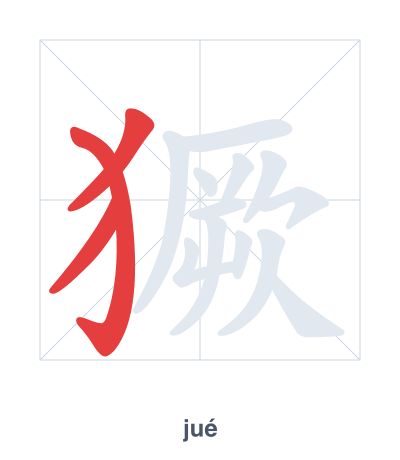
Open Hanzi Writer to see the animated stroke order and practice writing 獗 with real-time feedback.
The character 獗 (jué) is written with 15 strokes. Follow the standard Chinese stroke order: top to bottom, left to right, outside before inside. The radical 犭 is one of its key components.
Practice the correct stroke order with the Hanzi Writer app to see animated stroke-by-stroke guidance with real-time feedback.
獗 means Rampant; unrestrained.
獗 combines the radical 犭 (dog/beast) with 厥 (jué, meaning 'to dig' or 'collapse'). A beast digging frantically or causing a collapse conveys the sense of wild, unrestrained behavior.
💡 Memory Tip: Picture a wild dog (犭) with two angry eyes (the left side of 厥) digging a hole so furiously that the ground collapses (the right '欠' part suggests falling), rampaging without control.
这种病最近很猖獗。
zhè zhǒng bìng zuì jìn hěn chāng jué
This disease has been rampant recently.
这种行为猖獗一时。
zhè zhǒng xíng wéi chāng jué yī shí
This behavior was rampant for a time.
盗贼的行为猖獗无度。
dào zéi de xíng wéi chāng jué wú dù
The thieves' activities are rampant and unrestrained.
Open Hanzi Writer to see the animated stroke order and practice writing 獗 with real-time feedback.
✨ Animated stroke order · Handwriting recognition · HSK-graded practice · Free to use
獗 has the radical 犭 (dog/wild animal) on the left, which hints at fierce or animal-like behavior. The right part 厥 provides the pronunciation jué and also suggests a sense of falling or exhaustion, reinforcing the idea of something running wild out of control.