猖 (chāng) means "Savage / Wild" in Chinese. It has 11 strokes with the radical 犭, and is HSK Level 7.
Rated 4.2/5 in difficulty (advanced).
Harder than 71% of HSK Level 7 characters.
Appears in 3+ common words including 猖狂 (chāng kuáng), 猖獗 (chāng jué), 猖披 (chāng pī).
Due to its 11 strokes, Hanzi Writer's error detection shows 猖 requires focused practice — most learners need 10+ attempts for consistent accuracy.
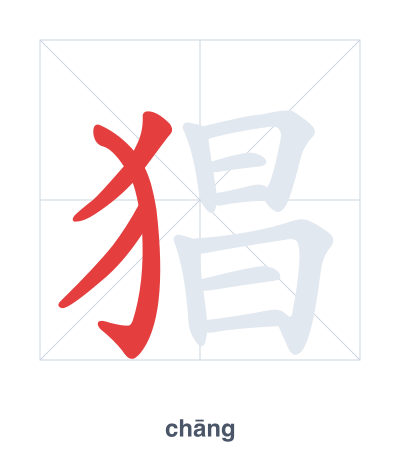
Open Hanzi Writer to see the animated stroke order and practice writing 猖 with real-time feedback.
The character 猖 (chāng) is written with 11 strokes. Follow the standard Chinese stroke order: top to bottom, left to right, outside before inside. The radical 犭 is one of its key components.
Practice the correct stroke order with the Hanzi Writer app to see animated stroke-by-stroke guidance with real-time feedback.
猖 means Savage / Wild.
As an HSK Level 7 character, 猖 is an intermediate-level character.
This character combines the dog radical 犭 (quǎn) with the phonetic component 昌 (chāng, meaning 'prosperous' but used here for sound). It depicts a dog behaving wildly or savagely, evoking the idea of a rabid animal running amok.
💡 Memory Tip: Picture a dog (犭) howling madly under two blazing suns (昌) — its wild raving makes it savage.
他的态度非常猖狂。
tā de tài dù fēi cháng chāng kuáng
His attitude is extremely arrogant and wild.
这种病毒最近很猖獗。
zhè zhǒng bìng dú zuì jìn hěn chāng jué
This virus has been rampant recently.
他的头发猖披在肩上。
tā de tóu fà chāng pī zài jiān shàng
His hair is disheveled over his shoulders.
Open Hanzi Writer to see the animated stroke order and practice writing 猖 with real-time feedback.
✨ Animated stroke order · Handwriting recognition · HSK-graded practice · Free to use
猖 is composed of the radical 犭 (dog/animal) on the left and the phonetic component 昌 (chāng) on the right. The radical 犭 indicates the meaning is related to animalistic or wild behavior, while 昌 provides the pronunciation. Together they form a character meaning "savage" or "wild."