獍 (jìng) means "A mythical beast said to eat its mother" in Chinese. It has 14 strokes with the radical 犭.
Rated 4.2/5 in difficulty (advanced).
Appears in 3+ common words including 枭獍 (xiāo jìng), 獍兽 (jìng shòu), 破獍 (pò jìng).
Due to its 14 strokes, Hanzi Writer's error detection shows 獍 requires focused practice — most learners need 10+ attempts for consistent accuracy.
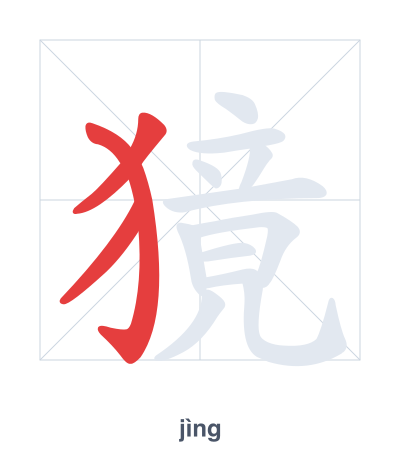
Open Hanzi Writer to see the animated stroke order and practice writing 獍 with real-time feedback.
The character 獍 (jìng) is written with 14 strokes. Follow the standard Chinese stroke order: top to bottom, left to right, outside before inside. The radical 犭 is one of its key components.
Practice the correct stroke order with the Hanzi Writer app to see animated stroke-by-stroke guidance with real-time feedback.
獍 means A mythical beast said to eat its mother.
The character 獍 combines the beast radical 犭 with the phonetic component 竟 (jìng), which also carries the sense of 'end' or 'finally' — an allusion to this mythical creature's gruesome act of eating its own mother, thus ending her life.
💡 Memory Tip: Picture a beast (犭) that finally (竟) devours its own mother.
枭獍是传说中的兽。
xiāo jìng shì chuán shuō zhōng de shòu
Xiaojing are legendary beasts.
这种獍兽很凶猛。
zhè zhǒng jìng shòu hěn xiōng měng
This Jing beast is very fierce.
破獍是一种古称。
pò jìng shì yī zhǒng gǔ chēng
'Pojing' is an ancient name.
Open Hanzi Writer to see the animated stroke order and practice writing 獍 with real-time feedback.
✨ Animated stroke order · Handwriting recognition · HSK-graded practice · Free to use
獍 combines the radical 犭 (animal) on the left with 竟 (jìng) on the right, which gives the sound. The radical 犭 indicates it is a kind of beast, and the full character refers to a mythical creature known for eating its mother. So the structure simply marks it as an animal, with the sound supplied by 竟.