猿 (yuán) means "Ape" in Chinese. It has 13 strokes with the radical 犭.
Rated 4.2/5 in difficulty (advanced).
Appears in 3+ common words including 猿猴 (yuán hóu), 猿人 (yuán rén), 类人猿 (lèi rén yuán).
Due to its 13 strokes, Hanzi Writer's error detection shows 猿 requires focused practice — most learners need 10+ attempts for consistent accuracy.
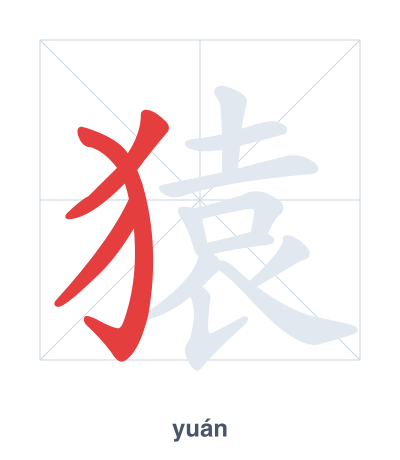
Open Hanzi Writer to see the animated stroke order and practice writing 猿 with real-time feedback.
The character 猿 (yuán) is written with 13 strokes. Follow the standard Chinese stroke order: top to bottom, left to right, outside before inside. The radical 犭 is one of its key components.
Practice the correct stroke order with the Hanzi Writer app to see animated stroke-by-stroke guidance with real-time feedback.
猿 means Ape.
This character is a semantic-phonetic compound: the left side 犭 (animal radical) indicates it's a creature, while the right side 袁 (yuán, originally picturing a person in a long robe) supplies the pronunciation and hints at human-like features. Together, 猿 specifies an ape—an animal that resembles humans in form and behavior.
💡 Memory Tip: Picture a furry ape (犭) wearing a long, flowing robe (袁), pretending to be human.
猿猴在树上跳。
yuán hóu zài shù shàng tiào
Apes and monkeys are jumping in the trees.
北京猿人很有名。
běi jīng yuán rén hěn yǒu míng
Peking Man is very famous.
类人猿和人很像。
lèi rén yuán hé rén hěn xiàng
Anthropoid apes are very similar to humans.
Open Hanzi Writer to see the animated stroke order and practice writing 猿 with real-time feedback.
✨ Animated stroke order · Handwriting recognition · HSK-graded practice · Free to use
The character 猿 is made of the radical 犭, meaning 'animal', on the left, and the phonetic component 袁 (yuán) on the right. The radical shows that an ape is a type of animal, while 袁 gives the pronunciation. Together, they form the character for 'ape'.