律 (lǜ) means "Law / rule / rhythm" in Chinese. It has 9 strokes with the radical 彳, and is HSK Level 4.
Rated 4/5 in difficulty (challenging).
Harder than 58% of HSK Level 4 characters.
Appears in 3+ common words including 法律 (fǎ lǜ), 律师 (lǜ shī), 纪律 (jì lǜ).
Due to its 9 strokes, Hanzi Writer's error detection shows 律 requires focused practice — most learners need 10+ attempts for consistent accuracy.
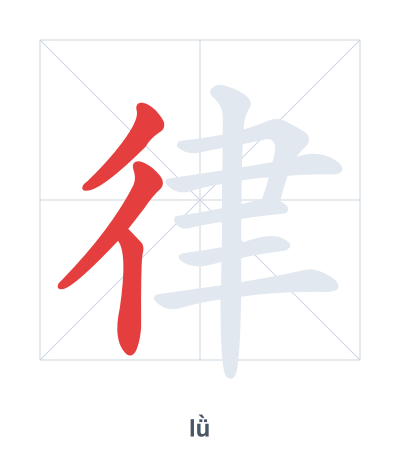
Open Hanzi Writer to see the animated stroke order and practice writing 律 with real-time feedback.
The character 律 (lǜ) is written with 9 strokes. Follow the standard Chinese stroke order: top to bottom, left to right, outside before inside. The radical 彳 is one of its key components.
Practice the correct stroke order with the Hanzi Writer app to see animated stroke-by-stroke guidance with real-time feedback.
律 means Law / rule / rhythm.
As an HSK Level 4 character, 律 is an intermediate-level character.
律 combines the radical 彳 (a step or path) with 聿, which originally pictured a hand holding a brush—together they suggest 'following a written standard.' This evolved to mean laws and rules that guide behavior, and also the regular beat of rhythm as a kind of patterned rule.
💡 Memory Tip: Imagine a judge (聿, the brush) stepping (彳) onto a scale, marking a strict law for every step you take.
我们要遵守法律。
wǒ men yào zūn shǒu fǎ lǜ
We must obey the law.
他的爸爸是律师。
tā de bà bà shì lǜ shī
His father is a lawyer.
学生要遵守纪律。
xué shēng yào zūn shǒu jì lǜ
Students must follow the rules.
Open Hanzi Writer to see the animated stroke order and practice writing 律 with real-time feedback.
✨ Animated stroke order · Handwriting recognition · HSK-graded practice · Free to use
The character 律 has a left radical 彳 (meaning 'step' or 'walk') and a right component 聿 (which originally represented a brush used for writing). Together, they suggest 'rules written down' that guide people's actions, which is why 律 means 'law' or 'rule'.