瘠 (jí) means "lean; barren; thin" in Chinese. It has 15 strokes with the radical 疒.
Rated 4.2/5 in difficulty (advanced).
Appears in 3+ common words including 贫瘠 (pín jí), 瘦瘠 (shòu jí), 瘠薄 (jí bó).
Due to its 15 strokes, Hanzi Writer's error detection shows 瘠 requires focused practice — most learners need 10+ attempts for consistent accuracy.
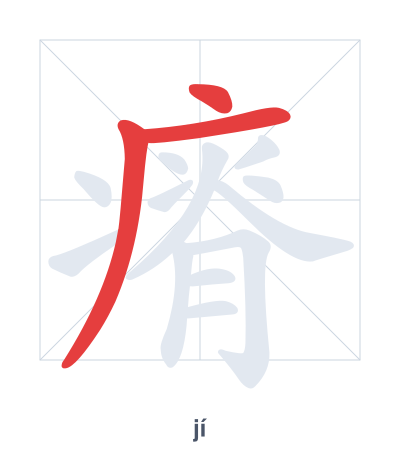
Open Hanzi Writer to see the animated stroke order and practice writing 瘠 with real-time feedback.
The character 瘠 (jí) is written with 15 strokes. Follow the standard Chinese stroke order: top to bottom, left to right, outside before inside. The radical 疒 is one of its key components.
Practice the correct stroke order with the Hanzi Writer app to see animated stroke-by-stroke guidance with real-time feedback.
瘠 means lean; barren; thin.
瘠 combines the sickness radical 疒 with 脊 (spine/backbone). The radical indicates a diseased or unhealthy state, while 脊 suggests the spine protruding prominently. Together, they depict a person so emaciated or a land so barren that the backbone-like ridges show through.
💡 Memory Tip: Imagine a sick person (疒) whose spine (脊) sticks out because they're so thin and malnourished—that's 瘠 (lean and barren).
这里的土地很贫瘠。
zhè lǐ de tǔ dì hěn pín jí
The land here is very barren.
那只羊非常瘦瘠。
nà zhǐ yáng fēi cháng shòu jí
That sheep is very thin and emaciated.
这里的土层很瘠薄。
zhè lǐ de tǔ céng hěn jí bó
The soil layer here is thin and infertile.
Open Hanzi Writer to see the animated stroke order and practice writing 瘠 with real-time feedback.
✨ Animated stroke order · Handwriting recognition · HSK-graded practice · Free to use
The character 瘠 has the radical 疒 (illness) on the left, and the component 脊 (spine/ridge) on the right. The radical suggests a sick or unhealthy condition, while 脊 hints at a backbone that sticks out, together showing a body that is lean or barren like thin soil.