获 (huò) means "to get; to obtain; to harvest" in Chinese. It has 10 strokes with the radical 艹, and is HSK Level 4.
Rated 4.2/5 in difficulty (advanced).
Harder than 89% of HSK Level 4 characters.
Appears in 3+ common words including 获得 (huò dé), 收获 (shōu huò), 获奖 (huò jiǎng).
Due to its 10 strokes, Hanzi Writer's error detection shows 获 requires focused practice — most learners need 10+ attempts for consistent accuracy.
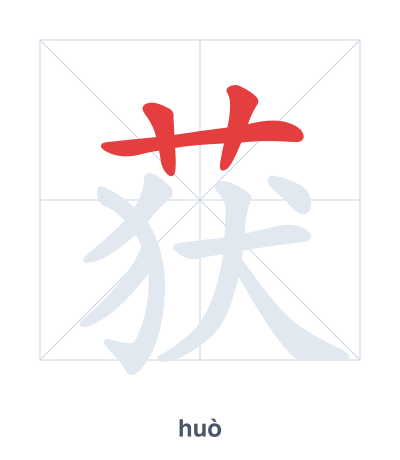
Open Hanzi Writer to see the animated stroke order and practice writing 获 with real-time feedback.
The character 获 (huò) is written with 10 strokes. Follow the standard Chinese stroke order: top to bottom, left to right, outside before inside. The radical 艹 is one of its key components.
Practice the correct stroke order with the Hanzi Writer app to see animated stroke-by-stroke guidance with real-time feedback.
获 means to get; to obtain; to harvest.
As an HSK Level 4 character, 获 is an intermediate-level character.
The character 获 combines the grass radical 艹 (plant), the dog radical 犭 (hunting), and the hand radical 又 (action). Originally depicting a hand catching prey with a dog in the grasslands, it evolved to mean both hunting and harvesting crops.
💡 Memory Tip: Imagine a dog (犭) helping your hand (又) pull a big grass (艹) plant to get the harvest.
他获得了一等奖。
tā huò dé le yì děng jiǎng
He won the first prize.
农民在忙着收获。
nóng mín zài máng zhe shōu huò
Farmers are busy harvesting.
他的作品获奖了。
tā de zuò pǐn huò jiǎng le
His work won an award.
Open Hanzi Writer to see the animated stroke order and practice writing 获 with real-time feedback.
✨ Animated stroke order · Handwriting recognition · HSK-graded practice · Free to use
获 combines the radical 艹 (grass/plants) on top with 犬 (dog) and 亻 (person) below. The grass radical suggests a connection to plants or harvest, while the dog and person together hint at hunting or gathering activities. This combination reflects the original meaning of harvesting crops or capturing prey.