苒 (rǎn) means "luxuriant / passing of time" in Chinese. It has 8 strokes with the radical 艹.
Rated 3.7/5 in difficulty (challenging).
Appears in 3+ common words including 荏苒 (rěn rǎn), 苒苒 (rǎn rǎn), 苒若 (rǎn ruò).
Due to its 8 strokes, Hanzi Writer's error detection shows 苒 requires focused practice — most learners need 10+ attempts for consistent accuracy.
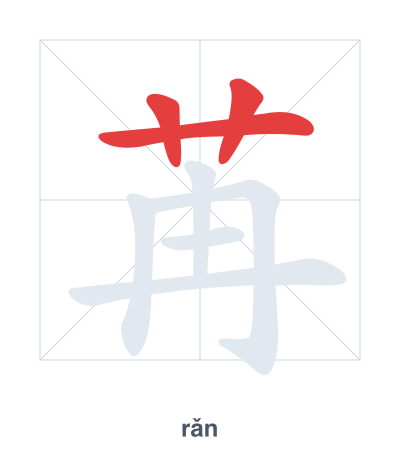
Open Hanzi Writer to see the animated stroke order and practice writing 苒 with real-time feedback.
The character 苒 (rǎn) is written with 8 strokes. Follow the standard Chinese stroke order: top to bottom, left to right, outside before inside. The radical 艹 is one of its key components.
Practice the correct stroke order with the Hanzi Writer app to see animated stroke-by-stroke guidance with real-time feedback.
苒 means luxuriant / passing of time.
The character 苒 is composed of the grass radical 艹 and the phonetic component 冉 (rǎn), which originally depicted a soft, drooping plant. Together, they convey the image of grass growing luxuriantly and gently swaying, which metaphorically extended to the gradual, soft passage of time.
💡 Memory Tip: Picture a field of grass (艹) slowly growing taller as a clock with soft, sweeping hands (冉) marks the passing time.
时光荏苒,岁月如梭。
shí guāng rěn rǎn suì yuè rú suō
Time flies, and years pass like a shuttle.
草木苒苒而生。
cǎo mù rǎn rǎn ér shēng
Plants and trees grow luxuriantly.
苒若云烟。
rǎn ruò yún yān
Like drifting clouds and smoke.
Open Hanzi Writer to see the animated stroke order and practice writing 苒 with real-time feedback.
✨ Animated stroke order · Handwriting recognition · HSK-graded practice · Free to use
苒 is composed of the radical 艹 (grass) on top and 冉 (rǎn) below, which contributes the sound. The 艹 radical relates to the meaning of 'luxuriant' (like lush grass), while the whole character is often used to describe the passing of time in the word 荏苒.