混 (hún/hùn) means "to mix; to confuse; to muddle along" in Chinese. It has 11 strokes with the radical 氵, and is HSK Level 6.
Rated 4.2/5 in difficulty (advanced).
Harder than 74% of HSK Level 6 characters.
Appears in 4+ common words including 混乱 (hùn luàn), 混合 (hùn hé), 混熟 (hùn shú).
Due to its 11 strokes, Hanzi Writer's error detection shows 混 requires focused practice — most learners need 10+ attempts for consistent accuracy.
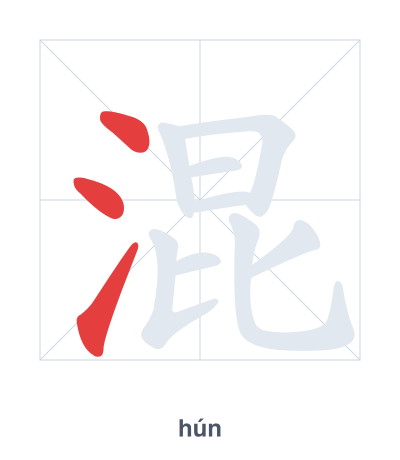
Open Hanzi Writer to see the animated stroke order and practice writing 混 with real-time feedback.
The character 混 (hún/hùn) is written with 11 strokes. Follow the standard Chinese stroke order: top to bottom, left to right, outside before inside. The radical 氵 is one of its key components.
Practice the correct stroke order with the Hanzi Writer app to see animated stroke-by-stroke guidance with real-time feedback.
混 means to mix; to confuse; to muddle along.
This is a polyphonic character with readings: hún, hùn.
As an HSK Level 6 character, 混 is an intermediate-level character.
混 combines the water radical (氵) with 昆 (kūn, meaning 'elder brother' but also serving as a phonetic). The original sense was 'muddy water'—water churning up sediment, which evolved into 'to mix' and 'to confuse.'
💡 Memory Tip: Picture water (氵) stirred by a giant bug (昆) until everything is a muddy, confusing mess.
现场的情况很混乱。
xiàn chǎng de qíng kuàng hěn hùn luàn
The situation at the scene is very chaotic.
请把这两种颜色混合。
qǐng bǎ zhè liǎng zhǒng yán sè hùn hé
Please mix these two colors.
我和新同学已经混熟了。
wǒ hé xīn tóng xué yǐ jīng hùn shú le
I've already become well-acquainted with my new classmates.
这条河里的水很混浊。
zhè tiáo hé lǐ de shuǐ hěn hún zhuó
The water in this river is very muddy.
Open Hanzi Writer to see the animated stroke order and practice writing 混 with real-time feedback.
✨ Animated stroke order · Handwriting recognition · HSK-graded practice · Free to use
混 is made of the water radical 氵 on the left and 昆 (kūn) on the right. The water radical suggests mixing or blending, like water mixing with other substances. The right part 昆 originally meant "elder brother" but here hints at a large group, so together they convey mixing many things together, leading to meanings like "to mix" or "to confuse."