熟 (shú) means "Cooked / Ripe / Familiar" in Chinese. It has 15 strokes with the radical 灬, and is HSK Level 2.
Rated 3.7/5 in difficulty (challenging).
Harder than 84% of HSK Level 2 characters.
Appears in 3+ common words including 熟人 (shú rén), 煮熟 (zhǔ shú), 成熟 (chéng shú).
Due to its 15 strokes, Hanzi Writer's error detection shows 熟 requires focused practice — most learners need 10+ attempts for consistent accuracy.
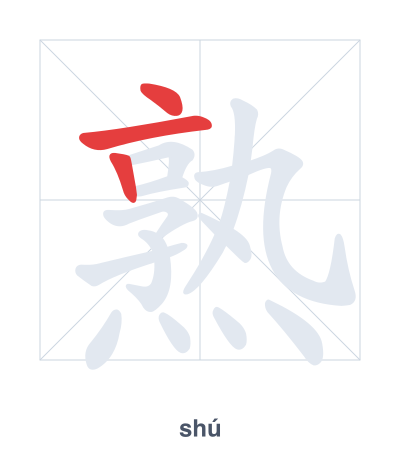
Open Hanzi Writer to see the animated stroke order and practice writing 熟 with real-time feedback.
The character 熟 (shú) is written with 15 strokes. Follow the standard Chinese stroke order: top to bottom, left to right, outside before inside. The radical 灬 is one of its key components.
Practice the correct stroke order with the Hanzi Writer app to see animated stroke-by-stroke guidance with real-time feedback.
熟 means Cooked / Ripe / Familiar.
As an HSK Level 2 character, 熟 is among the first characters beginners learn.
熟 combines the phonetic component 孰 (shú, originally meaning 'ripe' or 'cooked') with the fire radical 灬, indicating the heat needed for cooking or ripening. The left side of 孰 depicts a person (亻) offering (享) a round object (丸), likely food, which becomes familiar and ready to eat when heated.
💡 Memory Tip: Picture a person (亻) enjoying (享) a round dumpling (丸) that is cooked over fire (灬) until it is perfectly ripe and familiar.
他是一个熟人。
tā shì yí gè shú rén
He is an acquaintance.
肉已经煮熟了。
ròu yǐ jīng zhǔ shú le
The meat is already cooked.
这个苹果成熟了。
zhè ge píng guǒ chéng shú le
This apple is ripe.
Open Hanzi Writer to see the animated stroke order and practice writing 熟 with real-time feedback.
✨ Animated stroke order · Handwriting recognition · HSK-graded practice · Free to use
The character 熟 is composed of 孰 on top and 灬 (fire radical) on the bottom. The top part gives a hint to the pronunciation 'shú', while the bottom fire radical suggests cooking or ripening through heat. Together, they indicate something that has been cooked or has become ripe or familiar.