绘 (huì) means "To draw or paint." in Chinese. It has 9 strokes with the radical 纟, and is HSK Level 6.
Rated 4/5 in difficulty (challenging).
Harder than 53% of HSK Level 6 characters.
Appears in 3+ common words including 绘画 (huì huà), 绘本 (huì běn), 描绘 (miáo huì).
Due to its 9 strokes, Hanzi Writer's error detection shows 绘 requires focused practice — most learners need 10+ attempts for consistent accuracy.
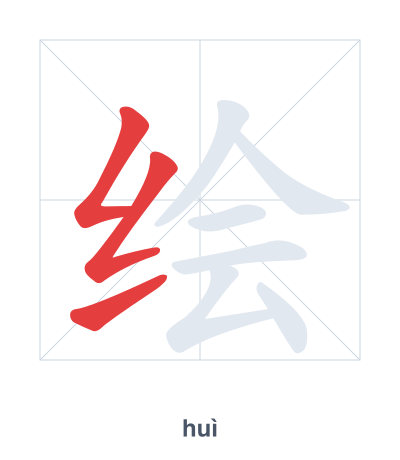
Open Hanzi Writer to see the animated stroke order and practice writing 绘 with real-time feedback.
The character 绘 (huì) is written with 9 strokes. Follow the standard Chinese stroke order: top to bottom, left to right, outside before inside. The radical 纟 is one of its key components.
Practice the correct stroke order with the Hanzi Writer app to see animated stroke-by-stroke guidance with real-time feedback.
绘 means To draw or paint..
As an HSK Level 6 character, 绘 is an intermediate-level character.
绘 combines the radical 纟 (silk thread) with 会 (to assemble, also phonetic), originally referring to embroidering or drawing with fine, thread-like lines—as if assembling images from silk fibers.
💡 Memory Tip: Picture a silk thread (纟) that 'meets' (会) the paper to weave a colorful painting.
他很喜欢绘画。
tā hěn xǐ huān huì huà
He likes painting and drawing very much.
这本书是绘本。
zhè běn shū shì huì běn
This book is a picture book.
他在描绘美景。
tā zài miáo huì měi jǐng
He is depicting the beautiful scenery.
Open Hanzi Writer to see the animated stroke order and practice writing 绘 with real-time feedback.
✨ Animated stroke order · Handwriting recognition · HSK-graded practice · Free to use
绘 is composed of the radical 纟 (silk) on the left and the phonetic component 会 (huì, meaning 'meet' or 'assemble') on the right. The silk radical suggests fine threads or lines, while 会 hints at combining or assembling those lines together to create a drawing or painting.