谎 (huǎng) means "lie" in Chinese. It has 11 strokes with the radical 讠, and is HSK Level 7.
Rated 3.9/5 in difficulty (challenging).
Harder than 36% of HSK Level 7 characters.
Appears in 3+ common words including 说谎 (shuō huǎng), 谎话 (huǎng huà), 谎言 (huǎng yán).
Due to its 11 strokes, Hanzi Writer's error detection shows 谎 requires focused practice — most learners need 10+ attempts for consistent accuracy.
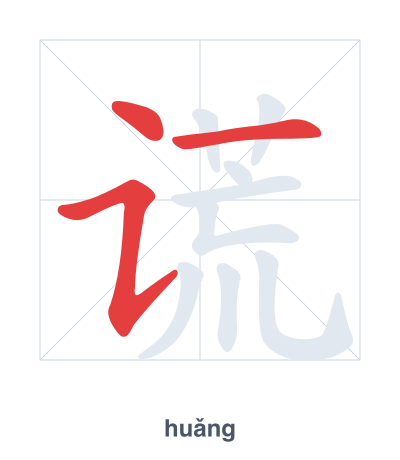
Open Hanzi Writer to see the animated stroke order and practice writing 谎 with real-time feedback.
The character 谎 (huǎng) is written with 11 strokes. Follow the standard Chinese stroke order: top to bottom, left to right, outside before inside. The radical 讠 is one of its key components.
Practice the correct stroke order with the Hanzi Writer app to see animated stroke-by-stroke guidance with real-time feedback.
谎 means lie.
As an HSK Level 7 character, 谎 is an intermediate-level character.
This character combines the speech radical 讠 with 荒 (huāng, meaning 'wild' or 'absurd'), indicating that a lie is wild or absurd speech. The component 荒 acts as a phonetic hint for pronunciation.
💡 Memory Tip: Imagine a speaker (讠) yelling a wild (荒) story about a field of grass that grows upside down — that's a lie!
孩子不应该说谎。
hái zi bù yīng gāi shuō huǎng
Children should not tell lies.
他从来不说谎话。
tā cóng lái bù shuō huǎng huà
He never tells lies.
这是一个美丽的谎言。
zhè shì yí gè měi lì de huǎng yán
This is a beautiful lie.
Open Hanzi Writer to see the animated stroke order and practice writing 谎 with real-time feedback.
✨ Animated stroke order · Handwriting recognition · HSK-graded practice · Free to use
The character 谎 is composed of two parts: the radical 讠 (speech) on the left, and 荒 (huāng, meaning 'wild' or 'barren') on the right. The combination suggests that a lie is like 'wild speech' — words that are not true or controlled.