以 (yǐ) means "with; by; in order to" in Chinese. It has 4 strokes with the radical 人, and is HSK Level 2.
Rated 1.9/5 in difficulty (beginner-friendly).
Harder than 5% of HSK Level 2 characters.
Appears in 3+ common words including 以后 (yǐ hòu), 以前 (yǐ qián), 可以 (kě yǐ).
In the Hanzi Writer app, most learners master 以 within 3 practice attempts using stroke-by-stroke animation.
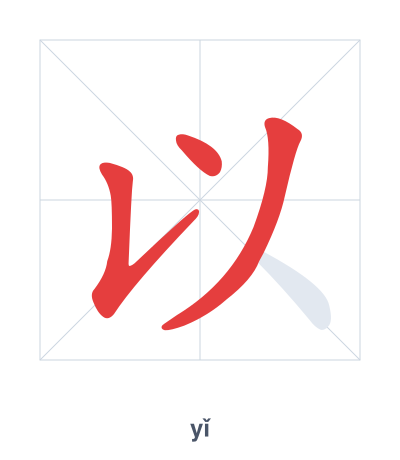
Open Hanzi Writer to see the animated stroke order and practice writing 以 with real-time feedback.
The character 以 (yǐ) is written with 4 strokes. Follow the standard Chinese stroke order: top to bottom, left to right, outside before inside. The radical 人 is one of its key components.
Practice the correct stroke order with the Hanzi Writer app to see animated stroke-by-stroke guidance with real-time feedback.
以 means with; by; in order to.
As an HSK Level 2 character, 以 is among the first characters beginners learn.
Originally a pictograph of a plough (㠯) with a person (人) beside it, meaning 'to use' or 'with'. The person indicates using the tool, thus conveying the sense of employing something as a means.
💡 Memory Tip: Picture a person (人) using a hook (the right part) to pull a load, showing 'with' this tool.
吃饭以后去散步。
chī fàn yǐ hòu qù sàn bù
Go for a walk after eating.
我以前住在这里。
wǒ yǐ qián zhù zài zhè lǐ
I used to live here.
我可以坐这里吗?
wǒ kě yǐ zuò zhè lǐ ma
Can I sit here?
Open Hanzi Writer to see the animated stroke order and practice writing 以 with real-time feedback.
✨ Animated stroke order · Handwriting recognition · HSK-graded practice · Free to use
The character 以 combines a person (人) on the left with a pictographic shape on the right that originally showed a tool or a plow. This structure suggests a person using a tool to do something, which connects to its meanings of 'with,' 'by,' or 'in order to.' The radical 人 (person) hints at human action, while the right side indicates the means or purpose.