哼 (hēng) means "To hum / To groan / Humph!" in Chinese. It has 10 strokes with the radical 口, and is HSK Level 7.
Rated 4.2/5 in difficulty (advanced).
Harder than 48% of HSK Level 7 characters.
Appears in 3+ common words including 哼歌 (hēng gē), 哼一声 (hēng yī shēng), 哼唱 (hēng chàng).
Due to its 10 strokes, Hanzi Writer's error detection shows 哼 requires focused practice — most learners need 10+ attempts for consistent accuracy.
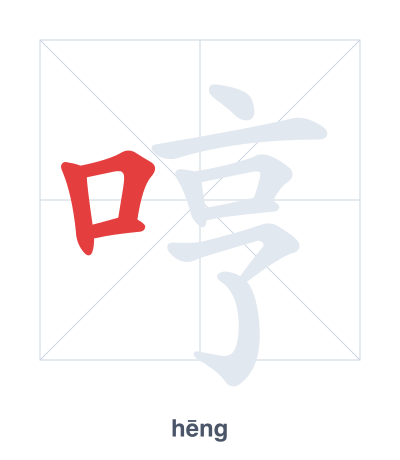
Open Hanzi Writer to see the animated stroke order and practice writing 哼 with real-time feedback.
The character 哼 (hēng) is written with 10 strokes. Follow the standard Chinese stroke order: top to bottom, left to right, outside before inside. The radical 口 is one of its key components.
Practice the correct stroke order with the Hanzi Writer app to see animated stroke-by-stroke guidance with real-time feedback.
哼 means To hum / To groan / Humph!.
As an HSK Level 7 character, 哼 is an intermediate-level character.
哼 is a phono-semantic compound combining the radical 口 (mouth) with 亨 (hēng), which provides the sound. The mouth radical indicates that the character relates to sounds made by the mouth, like humming or groaning.
💡 Memory Tip: Imagine opening your mouth (口) wide and letting out a deep 'Hmmm' sound that resonates through the box-like shape of 亨.
他一边走一边哼歌。
tā yī biān zǒu yī biān hēng gē
He hums while walking.
他只是冷冷地哼一声。
tā zhǐ shì lěng lěng dì hēng yī shēng
He just gave a cold snort.
妹妹在小声哼唱。
mèi mèi zài xiǎo shēng hēng chàng
My younger sister is humming softly.
Open Hanzi Writer to see the animated stroke order and practice writing 哼 with real-time feedback.
✨ Animated stroke order · Handwriting recognition · HSK-graded practice · Free to use
The character 哼 is made of the radical 口 (mouth) on the left and 亨 (hēng) on the right. The mouth radical suggests sounds coming from the mouth, while 亨 contributes the pronunciation and the idea of a muffled sound. Together they create the meanings of humming, groaning, or a scornful 'humph!'.