瓣 (bàn) means "petal or segment" in Chinese. It has 19 strokes with the radical 瓜, and is HSK Level 7.
Rated 3.8/5 in difficulty (challenging).
Harder than 33% of HSK Level 7 characters.
Appears in 3+ common words including 花瓣 (huā bàn), 蒜瓣 (suàn bàn), 豆瓣 (dòu bàn).
Due to its 19 strokes, Hanzi Writer's error detection shows 瓣 requires focused practice — most learners need 10+ attempts for consistent accuracy.
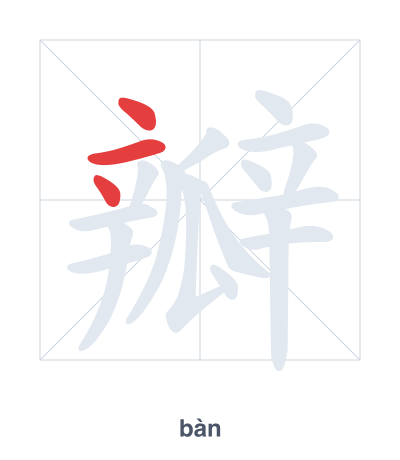
Open Hanzi Writer to see the animated stroke order and practice writing 瓣 with real-time feedback.
The character 瓣 (bàn) is written with 19 strokes. Follow the standard Chinese stroke order: top to bottom, left to right, outside before inside. The radical 瓜 is one of its key components.
Practice the correct stroke order with the Hanzi Writer app to see animated stroke-by-stroke guidance with real-time feedback.
瓣 means petal or segment.
As an HSK Level 7 character, 瓣 is an intermediate-level character.
瓣 combines the radical 瓜 (melon/gourd) with 辡 (biàn, meaning 'to distinguish' or 'split'), originally depicting the natural segments of a melon's interior. The left side signals the fruit, while the right side suggests division into separate parts, later extended to flower petals and any segment-like structure.
💡 Memory Tip: Picture a melon (瓜) split open to reveal two bitter seeds (辛辛) with spaces (欠) between them, like separate petals or segments.
花瓣掉在地上了。
huā bàn diào zài dì shàng le
The petals fell on the ground.
炒菜要放蒜瓣。
chǎo cài yào fàng suàn bàn
Add garlic cloves when stir-frying.
我喜欢吃豆瓣酱。
wǒ xǐ huān chī dòu bàn jiàng
I like eating broad bean paste.
Open Hanzi Writer to see the animated stroke order and practice writing 瓣 with real-time feedback.
✨ Animated stroke order · Handwriting recognition · HSK-graded practice · Free to use
The character 瓣 combines the radical 瓜 (melon) on the left with the phonetic component 辡 (biàn) on the right. The radical 瓜 hints at plant parts, so 瓣 originally describes segmented parts of fruits like melons. Today it means any natural segment or petal, such as a flower petal (花瓣) or a garlic clove (蒜瓣).