瓞 (dié) means "small melon" in Chinese. It has 10 strokes with the radical 瓜.
Rated 4.2/5 in difficulty (advanced).
Appears in 3+ common words including 瓜瓞 (guā dié), 小瓞 (xiǎo dié), 瓞儿 (dié ér).
Due to its 10 strokes, Hanzi Writer's error detection shows 瓞 requires focused practice — most learners need 10+ attempts for consistent accuracy.
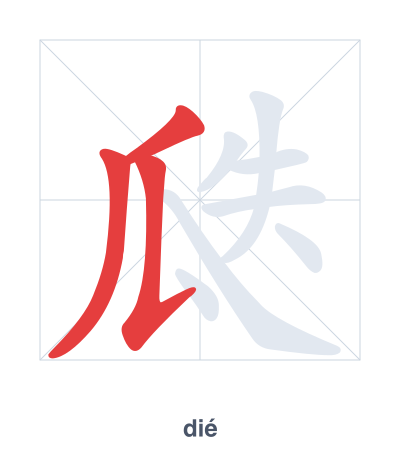
Open Hanzi Writer to see the animated stroke order and practice writing 瓞 with real-time feedback.
The character 瓞 (dié) is written with 10 strokes. Follow the standard Chinese stroke order: top to bottom, left to right, outside before inside. The radical 瓜 is one of its key components.
Practice the correct stroke order with the Hanzi Writer app to see animated stroke-by-stroke guidance with real-time feedback.
瓞 means small melon.
| Character | 瓞 |
| Pinyin | dié (die) |
| Meaning | small melon |
| Strokes | 10 |
| Radical | 瓜 |
| Difficulty | 4.2/5 |
瓞 is a phonetic compound: the radical 瓜 (melon) indicates the meaning 'melon', and the component 失 (shī) provides pronunciation (though the modern reading dié evolved differently). In ancient texts, 瓞 specifically referred to a small melon, as seen in the idiom '瓜瓞绵绵' (melons and small melons in endless succession) symbolizing abundant offspring.
💡 Memory Tip: Imagine a melon (瓜) that has 'lost' (失) its normal size because it's just a tiny little baby melon.
瓜瓞绵绵是成语。
guā dié mián mián shì chéng yǔ
'Guadie mianmian' is an idiom (referring to many descendants).
这是一个小瓞。
zhè shì yí gè xiǎo dié
This is a small melon.
瓞儿长在藤上。
dié ér zhǎng zài téng shàng
Small melons grow on the vine.
Open Hanzi Writer to see the animated stroke order and practice writing 瓞 with real-time feedback.
✨ Animated stroke order · Handwriting recognition · HSK-graded practice · Free to use
瓞 is composed of the radical 瓜 (melon) on the left and the phonetic component 失 (shī) on the right, but the right part actually hints at the sound "dié" rather than meaning. The radical clearly shows it is a type of melon, and the overall character refers to a small melon. So the left part gives the meaning, while the right part provides pronunciation.