固 (gù) means "Solid / Firm" in Chinese. It has 8 strokes with the radical 囗, and is HSK Level 4.
Rated 3.7/5 in difficulty (challenging).
Harder than 40% of HSK Level 4 characters.
Appears in 3+ common words including 固定 (gù dìng), 坚固 (jiān gù), 固体 (gù tǐ).
Due to its 8 strokes, Hanzi Writer's error detection shows 固 requires focused practice — most learners need 10+ attempts for consistent accuracy.
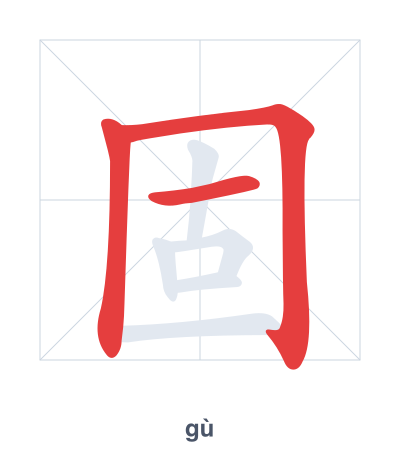
Open Hanzi Writer to see the animated stroke order and practice writing 固 with real-time feedback.
The character 固 (gù) is written with 8 strokes. Follow the standard Chinese stroke order: top to bottom, left to right, outside before inside. The radical 囗 is one of its key components.
Practice the correct stroke order with the Hanzi Writer app to see animated stroke-by-stroke guidance with real-time feedback.
固 means Solid / Firm.
As an HSK Level 4 character, 固 is an intermediate-level character.
固 combines a surrounding enclosure (囗) with 古 (old/ancient), suggesting an ancient fortified wall that is solid and enduring. The outer square represents a boundary or fence, while the inner element conveys something time-tested and firm.
💡 Memory Tip: Picture an old (古) stone fortress surrounded by a strong square wall (囗) that is completely solid and unbreakable.
他的工作不固定。
tā de gōng zuò bù gù dìng
His job is not stable.
这座桥很坚固。
zhè zuò qiáo hěn jiān gù
This bridge is very sturdy.
冰是固体。
bīng shì gù tǐ
Ice is a solid.
Open Hanzi Writer to see the animated stroke order and practice writing 固 with real-time feedback.
✨ Animated stroke order · Handwriting recognition · HSK-graded practice · Free to use
The character 固 consists of the outer radical 囗 (enclosure) and the inner component 古 (old). The enclosure suggests something contained or confined, while 古 implies something ancient and unchanging, together conveying the idea of being solid and firm.