囤 (dùn/tún) means "To store / To hoard / Bin" in Chinese. It has 7 strokes with the radical 囗.
Rated 3.5/5 in difficulty (challenging).
Appears in 4+ common words including 囤积 (tún jī), 囤聚 (tún jù), 粮囤 (liáng dùn).
Due to its 7 strokes, Hanzi Writer's error detection shows 囤 requires focused practice — most learners need 10+ attempts for consistent accuracy.
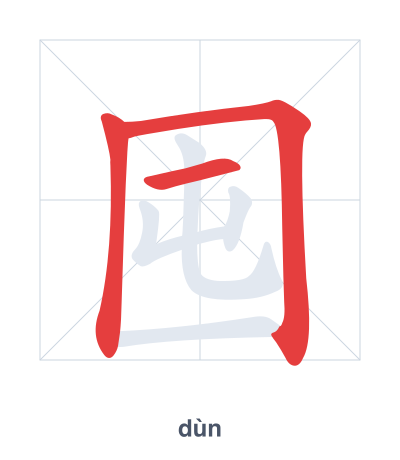
Open Hanzi Writer to see the animated stroke order and practice writing 囤 with real-time feedback.
The character 囤 (dùn/tún) is written with 7 strokes. Follow the standard Chinese stroke order: top to bottom, left to right, outside before inside. The radical 囗 is one of its key components.
Practice the correct stroke order with the Hanzi Writer app to see animated stroke-by-stroke guidance with real-time feedback.
囤 means To store / To hoard / Bin.
This is a polyphonic character with readings: dùn, tún.
The character 囤 combines the radical 囗 (enclosure) with 屯 (tún, meaning 'to store up' or 'to gather'). 屯 provides phonetic and semantic hints, while 囗 emphasizes the idea of a confined space like a bin or granary. Together, they depict a container used for hoarding or storing goods.
💡 Memory Tip: Imagine a giant square box (囗) crammed full of grain (屯) that you're hoarding for winter.
严禁投机倒把,恶意囤积紧缺的生活物资。
yán jìn tóu jī dǎo bǎ è yì tún jī jǐn quē de shēng huó wù zī
Speculation and malicious hoarding of scarce daily necessities are strictly prohibited.
大量的积压物资被囤聚在港口的仓库里。
dà liàng de jī yā wù zī bèi tún jù zài gǎng kǒu de cāng kù lǐ
A large amount of backlogged materials is stockpiled in the port warehouses.
以前的农家小院里经常能看到圆圆的粮囤。
yǐ qián de nóng jiā xiǎo yuàn lǐ jīng cháng néng kàn dào yuán yuán de liáng dùn
In the past, round granaries were often seen in farmhouse courtyards.
今年收成好,家里的谷囤装得满满当当。
jīn nián shōu chéng hǎo jiā lǐ de gǔ dùn zhuāng dé mǎn mǎn dāng dāng
This year's harvest is good, and the granaries at home are filled to the brim.
Open Hanzi Writer to see the animated stroke order and practice writing 囤 with real-time feedback.
✨ Animated stroke order · Handwriting recognition · HSK-graded practice · Free to use
囤 has an outer radical 囗 (wéi), which means "enclosure" or "box," and an inner part 屯 (tún), which means "to store up." The box-like enclosure holds the idea of storing things inside, so together they represent a bin or hoarding.