囝 (jiǎn) means "Child; son (dialect)." in Chinese. It has 6 strokes with the radical 囗.
Rated 3.2/5 in difficulty (challenging).
Appears in 3+ common words including 囝仔 (jiǎn zǎi), 小囝 (xiǎo jiǎn), 囝囝 (jiǎn jiǎn).
Due to its 6 strokes, Hanzi Writer's error detection shows 囝 requires focused practice — most learners need 10+ attempts for consistent accuracy.
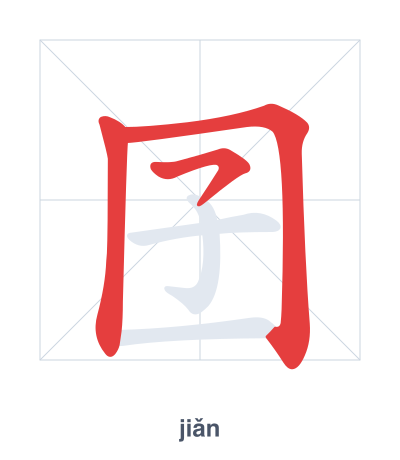
Open Hanzi Writer to see the animated stroke order and practice writing 囝 with real-time feedback.
The character 囝 (jiǎn) is written with 6 strokes. Follow the standard Chinese stroke order: top to bottom, left to right, outside before inside. The radical 囗 is one of its key components.
Practice the correct stroke order with the Hanzi Writer app to see animated stroke-by-stroke guidance with real-time feedback.
囝 means Child; son (dialect)..
The character 囝 combines the radical 囗 (enclosure) with 子 (child), picturing a child within a home or family. This structure suggests a son or child kept close, reflecting its dialect meaning of 'child' or 'son'.
💡 Memory Tip: Imagine a child (子) enclosed in a square playpen (囗) — that's the little son (囝) playing safely at home.
那个囝仔很可爱。
nà ge jiǎn zǎi hěn kě ài
That child is very cute.
小囝在睡觉。
xiǎo jiǎn zài shuì jiào
The child is sleeping.
囝囝快过来。
jiǎn jiǎn kuài guò lái
Baby, come here quickly.
Open Hanzi Writer to see the animated stroke order and practice writing 囝 with real-time feedback.
✨ Animated stroke order · Handwriting recognition · HSK-graded practice · Free to use
囝 is made of the radical 囗 (enclosure) and 子 (child). The enclosure 囗 suggests a home or boundary, while 子 means child or son, so together they convey the idea of a child inside the family circle.