囡 (nān) means "Little girl / Child (dialect)" in Chinese. It has 6 strokes with the radical 囗.
Rated 3.2/5 in difficulty (challenging).
Appears in 3+ common words including 囡囡 (nān nān), 小囡 (xiǎo nān), 乖囡 (guāi nān).
Due to its 6 strokes, Hanzi Writer's error detection shows 囡 requires focused practice — most learners need 10+ attempts for consistent accuracy.
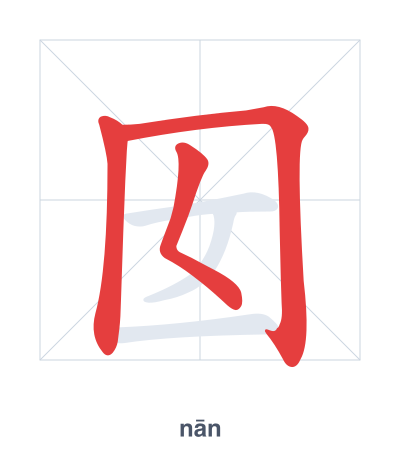
Open Hanzi Writer to see the animated stroke order and practice writing 囡 with real-time feedback.
The character 囡 (nān) is written with 6 strokes. Follow the standard Chinese stroke order: top to bottom, left to right, outside before inside. The radical 囗 is one of its key components.
Practice the correct stroke order with the Hanzi Writer app to see animated stroke-by-stroke guidance with real-time feedback.
囡 means Little girl / Child (dialect).
囡 combines 囗 (enclosure) and 女 (woman/girl), picturing a young girl kept within the home or family circle. This structure emphasizes a protected or cherished little daughter, reflecting the dialectal meaning of 'little girl' or 'child.'
💡 Memory Tip: Imagine a little girl (女) trapped inside a square playpen (囗), crying 'Nān!' until someone lets her out.
囡囡真乖。
nān nān zhēn guāi
The little girl is so well-behaved.
这个小囡很漂亮。
zhè ge xiǎo nān hěn piào liàng
This little girl is very pretty.
乖囡,吃苹果吧。
guāi nān chī píng guǒ ba
Good girl, have an apple.
Open Hanzi Writer to see the animated stroke order and practice writing 囡 with real-time feedback.
✨ Animated stroke order · Handwriting recognition · HSK-graded practice · Free to use
囡 is made of an outer enclosure 囗, which looks like a frame or a room, and the inner component 女 meaning "woman" or "girl." Together they suggest a little girl inside a protected space, emphasizing the idea of a cherished child. This structure reflects the affectionate meaning of the character as a dialect word for a little girl.