囚 (qiú) means "Prisoner; to imprison." in Chinese. It has 5 strokes with the radical 囗, and is HSK Level 7.
Rated 2.9/5 in difficulty (moderate).
Harder than 6% of HSK Level 7 characters.
Appears in 3+ common words including 囚犯 (qiú fàn), 囚禁 (qiú jìn), 囚车 (qiú chē).
Hanzi Writer's stroke validation shows learners typically need 5-8 attempts to write 囚 with correct proportion and order.
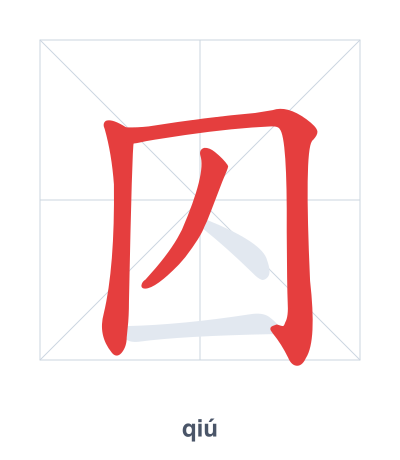
Open Hanzi Writer to see the animated stroke order and practice writing 囚 with real-time feedback.
The character 囚 (qiú) is written with 5 strokes. Follow the standard Chinese stroke order: top to bottom, left to right, outside before inside. The radical 囗 is one of its key components.
Practice the correct stroke order with the Hanzi Writer app to see animated stroke-by-stroke guidance with real-time feedback.
囚 means Prisoner; to imprison..
As an HSK Level 7 character, 囚 is an intermediate-level character.
囚 is a pictophonetic character. The outer component 囗 (wéi) represents an enclosure or a prison cell, and the inner component 人 (rén) represents a person. Together, they visually depict a person enclosed within walls, symbolizing imprisonment.
💡 Memory Tip: Imagine a person (人) trapped inside a square box (囗). The box has no doors, so they are stuck—this is a prisoner (囚).
警察带走了囚犯。
jǐng chá dài zǒu le qiú fàn
The police took the prisoner away.
他被囚禁在房间里。
tā bèi qiú jìn zài fáng jiān lǐ
He was imprisoned in the room.
囚车开往了监狱。
qiú chē kāi wǎng le jiān yù
The prison van headed to the jail.
Open Hanzi Writer to see the animated stroke order and practice writing 囚 with real-time feedback.
✨ Animated stroke order · Handwriting recognition · HSK-graded practice · Free to use
囚 is made of two parts: the outer radical 囗 (which means 'enclosure' or 'surround') and the inner part 人 (which means 'person'). The combination of these components literally shows a person inside an enclosure, which directly represents the idea of being imprisoned or confined. This structure is a clear example of how Chinese characters often combine visual elements to express abstract concepts.