囟 (xìn) means "Fontanelle (top of the head)" in Chinese. It has 6 strokes with the radical 囗.
Rated 3.2/5 in difficulty (challenging).
Appears in 3+ common words including 囟门 (xìn mén), 囟脑门 (xìn nǎo mén), 囟骨 (xìn gǔ).
Due to its 6 strokes, Hanzi Writer's error detection shows 囟 requires focused practice — most learners need 10+ attempts for consistent accuracy.
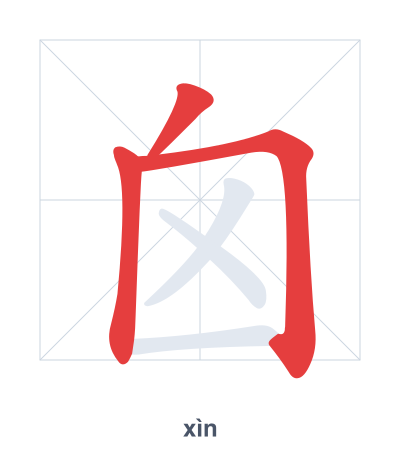
Open Hanzi Writer to see the animated stroke order and practice writing 囟 with real-time feedback.
The character 囟 (xìn) is written with 6 strokes. Follow the standard Chinese stroke order: top to bottom, left to right, outside before inside. The radical 囗 is one of its key components.
Practice the correct stroke order with the Hanzi Writer app to see animated stroke-by-stroke guidance with real-time feedback.
囟 means Fontanelle (top of the head).
This character is a pictograph of the soft spot on a baby's head. Its ancient form depicted a small cross or lines inside an enclosure (囗), representing the fontanelle as seen from above. The modern shape retains the enclosing outline with inner strokes indicating the unclosed skull bones.
💡 Memory Tip: Picture a baby's head with a square hat (囗) that has a tiny X-shape (the inner crosses) showing the soft spot where you can feel the pulse.
婴儿的囟门很软。
yīng ér de xìn mén hěn ruǎn
A baby's fontanelle is very soft.
他摸了摸囟脑门。
tā mō le mō xìn nǎo mén
He touched his forehead.
这是人的囟骨。
zhè shì rén de xìn gǔ
This is the human parietal bone.
Open Hanzi Writer to see the animated stroke order and practice writing 囟 with real-time feedback.
✨ Animated stroke order · Handwriting recognition · HSK-graded practice · Free to use
The character 囟 is built with the radical 囗 (enclosure) on the outside, representing the head, and a cross-like shape inside. This cross suggests the soft spot on a baby's skull where the bones have not yet joined, which is exactly what fontanelle means.