盖 (gài/gě) means "cover / lid / to cover" in Chinese. It has 11 strokes with the radical 皿, and is HSK Level 4.
Rated 4.2/5 in difficulty (advanced).
Harder than 81% of HSK Level 4 characters.
Appears in 4+ common words including 盖子 (gài zi), 覆盖 (fù gài), 姓盖 (xìng gài).
Due to its 11 strokes, Hanzi Writer's error detection shows 盖 requires focused practice — most learners need 10+ attempts for consistent accuracy.
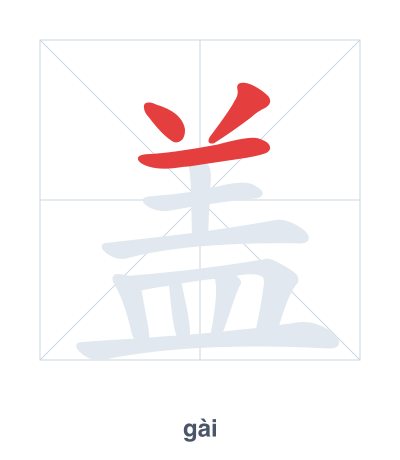
Open Hanzi Writer to see the animated stroke order and practice writing 盖 with real-time feedback.
The character 盖 (gài/gě) is written with 11 strokes. Follow the standard Chinese stroke order: top to bottom, left to right, outside before inside. The radical 皿 is one of its key components.
Practice the correct stroke order with the Hanzi Writer app to see animated stroke-by-stroke guidance with real-time feedback.
盖 means cover / lid / to cover.
This is a polyphonic character with readings: gài, gě.
As an HSK Level 4 character, 盖 is an intermediate-level character.
盖 combines the grass radical (艹) over the vessel radical (皿), suggesting a lid made of plant material covering a container. The original compound 盍 (now obsolete) depicted a lid over a vessel, and the grass component was added later to reinforce the idea of a natural cover.
💡 Memory Tip: Picture a grass mat (艹) placed over a bowl (皿) to cover it.
请把锅盖子盖好,这样菜热得比较快。
qǐng bǎ guō gài zi gài hǎo zhè yàng cài rè dé bǐ jiào kuài
Please cover the pot so the food heats up faster.
冬天的原野被厚厚的白雪全面覆盖了。
dōng tiān de yuán yě bèi hòu hòu de bái xuě quán miàn fù gài le
The winter fields are completely covered by thick white snow.
那位姓盖的教练在举重界非常有声望。
nà wèi xìng gài de jiào liàn zài jǔ zhòng jiè fēi cháng yǒu shēng wàng 。
The coach named Gai is very prestigious in the weightlifting world.
盖先生是我们村的医生。
gě xiān sheng shì wǒ men cūn de yī shēng
Mr. Gai is the doctor in our village.
Open Hanzi Writer to see the animated stroke order and practice writing 盖 with real-time feedback.
✨ Animated stroke order · Handwriting recognition · HSK-graded practice · Free to use
盖 is made of 羊 (sheep) on top and 皿 (container) below. The 皿 represents a bowl or vessel, and the 羊 on top suggests something covering it, like a lid. This structure directly relates to the character's meaning of "cover" or "lid."