皂 (zào) means "Soap" in Chinese. It has 7 strokes with the radical 白, and is HSK Level 7.
Rated 3.5/5 in difficulty (challenging).
Harder than 20% of HSK Level 7 characters.
Appears in 3+ common words including 肥皂 (féi zào), 香皂 (xiāng zào), 皂白 (zào bái).
Due to its 7 strokes, Hanzi Writer's error detection shows 皂 requires focused practice — most learners need 10+ attempts for consistent accuracy.
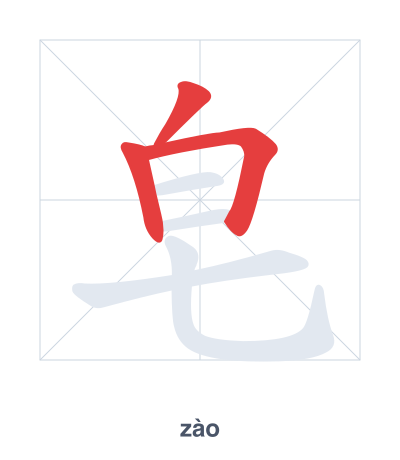
Open Hanzi Writer to see the animated stroke order and practice writing 皂 with real-time feedback.
The character 皂 (zào) is written with 7 strokes. Follow the standard Chinese stroke order: top to bottom, left to right, outside before inside. The radical 白 is one of its key components.
Practice the correct stroke order with the Hanzi Writer app to see animated stroke-by-stroke guidance with real-time feedback.
皂 means Soap.
As an HSK Level 7 character, 皂 is an intermediate-level character.
皂 originally referred to the soapberry plant, whose pods were used to create a cleaning lather. The character combines 白 (white) to symbolize the white foam and 匕 (ladle) to represent stirring or applying the soap.
💡 Memory Tip: Picture a white (白) ladle (匕) scooping up a heap of soap foam.
请用肥皂洗手。
qǐng yòng féi zào xǐ shǒu
Please wash your hands with soap.
这块香皂很香。
zhè kuài xiāng zào hěn xiāng
This bar of soap is very fragrant.
要分清青红皂白。
yào fēn qīng qīng hóng zào bái
One must distinguish right from wrong.
Open Hanzi Writer to see the animated stroke order and practice writing 皂 with real-time feedback.
✨ Animated stroke order · Handwriting recognition · HSK-graded practice · Free to use
皂 has the radical 白 (white) on top and the component 七 (seven) on the bottom. The white part visually suggests the clean white color of soap, while the bottom is a phonetic clue (though the connection is not perfect). This structure helps you associate the character with a bar of white soap.