踱 (duó) means "to pace; to stroll" in Chinese. It has 16 strokes with the radical 足.
Rated 4.2/5 in difficulty (advanced).
Appears in 3+ common words including 踱步 (duó bù), 踱来踱去 (duó lái duó qù), 慢踱 (màn duó).
Due to its 16 strokes, Hanzi Writer's error detection shows 踱 requires focused practice — most learners need 10+ attempts for consistent accuracy.
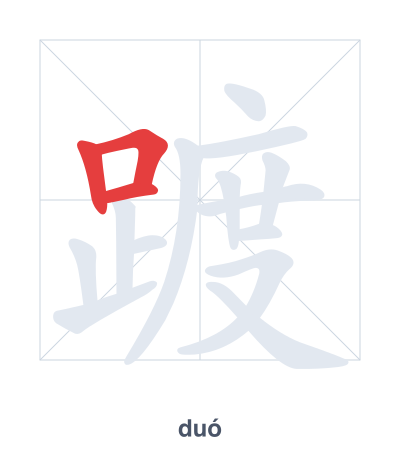
Open Hanzi Writer to see the animated stroke order and practice writing 踱 with real-time feedback.
The character 踱 (duó) is written with 16 strokes. Follow the standard Chinese stroke order: top to bottom, left to right, outside before inside. The radical 足 is one of its key components.
Practice the correct stroke order with the Hanzi Writer app to see animated stroke-by-stroke guidance with real-time feedback.
踱 means to pace; to stroll.
踱 is a compound character where the radical 足 (foot) indicates the action relates to walking, and the component 度 (dù, 'degree' or 'measure') provides pronunciation. The original meaning is to pace or stroll, as if measuring ground with one's steps.
💡 Memory Tip: Picture a person with a foot (足) measuring (度) the floor step by step as they pace back and forth.
他在房间里踱步。
tā zài fáng jiān lǐ duó bù
He is pacing in the room.
别在门口踱来踱去。
bié zài mén kǒu duó lái duó qù
Don't pace back and forth at the door.
他在公园慢踱。
tā zài gōng yuán màn duó
He is strolling slowly in the park.
Open Hanzi Writer to see the animated stroke order and practice writing 踱 with real-time feedback.
✨ Animated stroke order · Handwriting recognition · HSK-graded practice · Free to use
踱 is composed of the radical 足 (foot) on the left and the phonetic component 度 (dù, degree) on the right. The foot radical indicates the character relates to foot movement, while 度 suggests the idea of measuring or proceeding step by step. Together, they create the meaning of walking with measured steps, like pacing or strolling.