去 (qù) means "to go; to leave; past" in Chinese. It has 5 strokes with the radical 厶, and is HSK Level 1.
Rated 2.2/5 in difficulty (moderate).
Harder than 24% of HSK Level 1 characters.
Appears in 3+ common words including 去年 (qù nián), 回去 (huí qù), 过去 (guò qù).
Hanzi Writer's stroke validation shows learners typically need 5-8 attempts to write 去 with correct proportion and order.
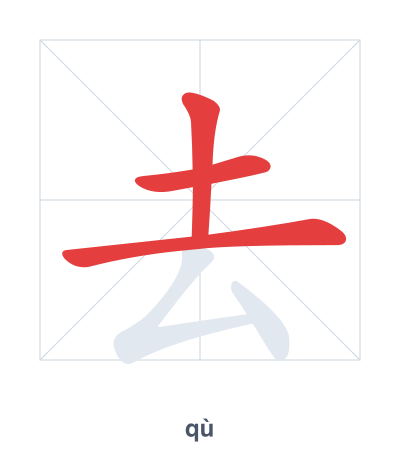
Open Hanzi Writer to see the animated stroke order and practice writing 去 with real-time feedback.
The character 去 (qù) is written with 5 strokes. Follow the standard Chinese stroke order: top to bottom, left to right, outside before inside. The radical 厶 is one of its key components.
Practice the correct stroke order with the Hanzi Writer app to see animated stroke-by-stroke guidance with real-time feedback.
去 means to go; to leave; past.
As an HSK Level 1 character, 去 is among the first characters beginners learn.
The character 去 originally depicted a person (大) leaving a cave or dwelling (口), combining to mean 'to go away' or 'depart'. Over time, the form simplified to the modern shape, with the top representing a person and the bottom a mouth or exit.
💡 Memory Tip: Picture a person with outstretched arms (the top of 去) stepping over a mouth (口) shouting 'Go!' to tell you to leave.
去年我去了中国。
qù nián wǒ qù le zhōng guó
I went to China last year.
我们现在回去吧。
wǒ men xiàn zài huí qù ba
Let's go back now.
过去的事不要提了。
guò qù de shì bú yào tí le
Don't mention the past.
Open Hanzi Writer to see the animated stroke order and practice writing 去 with real-time feedback.
✨ Animated stroke order · Handwriting recognition · HSK-graded practice · Free to use
The character 去 is made of two parts: the top is 土 (earth), and the bottom is 厶 (private). The combination does not directly show the meaning 'to go', but recognizing these components helps you remember the shape.