哆 (duō) means "to tremble; to shiver" in Chinese. It has 9 strokes with the radical 口, and is HSK Level 7.
Rated 4/5 in difficulty (challenging).
Harder than 38% of HSK Level 7 characters.
Appears in 3+ common words including 哆嗦 (duō suo), 哆 (duō), 哆哆嗦嗦 (duō duō suō suō).
Due to its 9 strokes, Hanzi Writer's error detection shows 哆 requires focused practice — most learners need 10+ attempts for consistent accuracy.
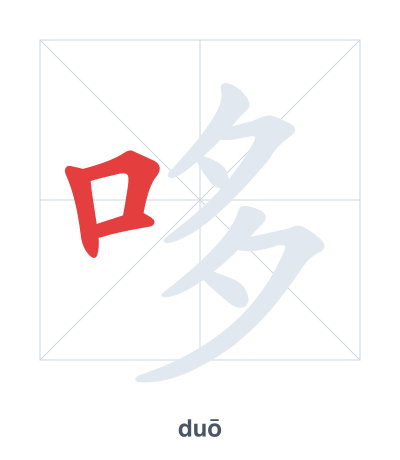
Open Hanzi Writer to see the animated stroke order and practice writing 哆 with real-time feedback.
The character 哆 (duō) is written with 9 strokes. Follow the standard Chinese stroke order: top to bottom, left to right, outside before inside. The radical 口 is one of its key components.
Practice the correct stroke order with the Hanzi Writer app to see animated stroke-by-stroke guidance with real-time feedback.
哆 means to tremble; to shiver.
As an HSK Level 7 character, 哆 is an intermediate-level character.
哆 is a phono-semantic compound. The radical 口 (mouth) hints at the mouth's involvement in trembling, like chattering teeth. The phonetic component 多 (duō, meaning 'many') both provides the sound and suggests the repetitive nature of shivering—many small, rapid movements.
💡 Memory Tip: Imagine your mouth (口) chattering many (多) times because you're shivering from cold.
他冷得直哆嗦。
tā lěng dé zhí duō suo
He was shivering uncontrollably from the cold.
这是音符哆。
zhè shì yīn fú duō
This is the musical note 'Do'.
他哆哆嗦嗦地说话。
tā duō duō suō suō dì shuō huà
He spoke tremblingly.
Open Hanzi Writer to see the animated stroke order and practice writing 哆 with real-time feedback.
✨ Animated stroke order · Handwriting recognition · HSK-graded practice · Free to use
哆 is made of the mouth radical 口 on the left and the character 多 (meaning "many") on the right. The mouth radical may suggest the sound of chattering teeth, while 多 hints at repeated or multiple movements, together creating the idea of trembling or shivering.