腹 (fù) means "abdomen" in Chinese. It has 13 strokes with the radical 月, and is HSK Level 7.
Rated 4.2/5 in difficulty (advanced).
Harder than 84% of HSK Level 7 characters.
Appears in 3+ common words including 腹部 (fù bù), 腹泻 (fù xiè), 腹肌 (fù jī).
Due to its 13 strokes, Hanzi Writer's error detection shows 腹 requires focused practice — most learners need 10+ attempts for consistent accuracy.
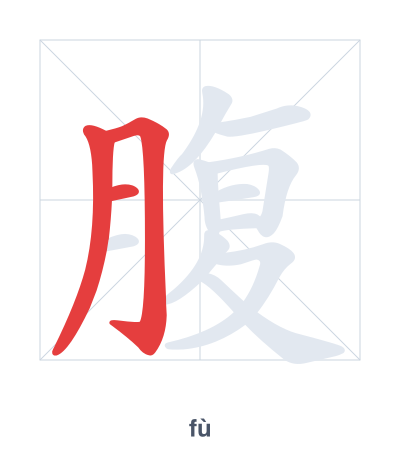
Open Hanzi Writer to see the animated stroke order and practice writing 腹 with real-time feedback.
The character 腹 (fù) is written with 13 strokes. Follow the standard Chinese stroke order: top to bottom, left to right, outside before inside. The radical 月 is one of its key components.
Practice the correct stroke order with the Hanzi Writer app to see animated stroke-by-stroke guidance with real-time feedback.
腹 means abdomen.
As an HSK Level 7 character, 腹 is an intermediate-level character.
The character 腹 is a phono-semantic compound: the left radical 月 (flesh) signifies a body part, while the right component 复 (fù) provides the sound and also subtly suggests the repeated (复) expansion and contraction of the abdomen during breathing. Together, they form the word for 'abdomen'.
💡 Memory Tip: Picture a belly (月) that goes in and out repeatedly (复) as you breathe deeply.
腹部肌肉很重要。
fù bù jī ròu hěn zhòng yào
Abdominal muscles are very important.
他昨天有点腹泻。
tā zuó tiān yǒu diǎn fù xiè
He had a bit of diarrhea yesterday.
他有六块腹肌。
tā yǒu liù kuài fù jī
He has six-pack abs.
Open Hanzi Writer to see the animated stroke order and practice writing 腹 with real-time feedback.
✨ Animated stroke order · Handwriting recognition · HSK-graded practice · Free to use
腹 is composed of two parts: the radical 月 (meat/flesh) on the left, and the phonetic component 复 on the right. The 月 radical indicates that the character relates to body parts, while 复 provides the pronunciation fù. Together, they form the word for "abdomen."