陡 (dǒu) means "steep" in Chinese. It has 9 strokes with the radical 阝, and is HSK Level 7.
Rated 3.7/5 in difficulty (challenging).
Harder than 32% of HSK Level 7 characters.
Appears in 3+ common words including 陡峭 (dǒu qiào), 陡坡 (dǒu pō), 陡然 (dǒu rán).
Due to its 9 strokes, Hanzi Writer's error detection shows 陡 requires focused practice — most learners need 10+ attempts for consistent accuracy.
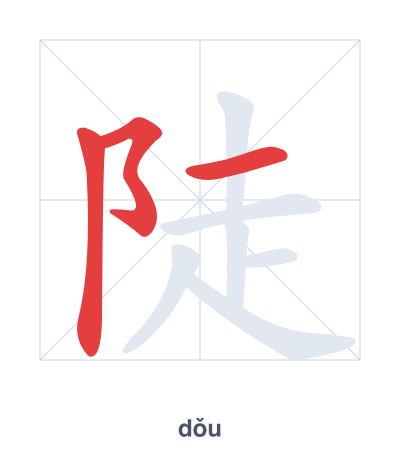
Open Hanzi Writer to see the animated stroke order and practice writing 陡 with real-time feedback.
The character 陡 (dǒu) is written with 9 strokes. Follow the standard Chinese stroke order: top to bottom, left to right, outside before inside. The radical 阝 is one of its key components.
Practice the correct stroke order with the Hanzi Writer app to see animated stroke-by-stroke guidance with real-time feedback.
陡 means steep.
As an HSK Level 7 character, 陡 is an intermediate-level character.
The left radical 阝 (from 阜) means a hill or mound. The right component 走 (zǒu) means 'to walk' or 'to run'. Together, they depict a hill so steep that walking up it is strenuous—hence 'steep'.
💡 Memory Tip: Imagine a person (走) struggling to climb a steep hill (阝), their legs burning as they try to keep from sliding back.
这座山很陡峭。
zhè zuò shān hěn dǒu qiào
This mountain is very steep.
前面有一个陡坡。
qián miàn yǒu yí gè dǒu pō
There is a steep slope ahead.
天气陡然变冷了。
tiān qì dǒu rán biàn lěng le
The weather suddenly turned cold.
Open Hanzi Writer to see the animated stroke order and practice writing 陡 with real-time feedback.
✨ Animated stroke order · Handwriting recognition · HSK-graded practice · Free to use
The left part is 阝 (a variant of 阜, meaning "mound" or "hill"), and the right part is 走 (meaning "walk") combined with an extra stroke. Together, they suggest a walkway on a steep hill, which connects to the meaning of "steep" or "precipitous."