Hanzi Writer

How to Write 颀 (qí) — Meaning “Tall (of a person)”

10 strokes Radical: 页

颀 (qí) means "Tall (of a person)" in Chinese. It has 10 strokes with the radical 页.

Rated 4.2/5 in difficulty (advanced).

Appears in 3+ common words including 颀长 (qí cháng), 颀伟 (qí wěi), 颀然 (qí rán).

Due to its 10 strokes, Hanzi Writer's error detection shows 颀 requires focused practice — most learners need 10+ attempts for consistent accuracy.
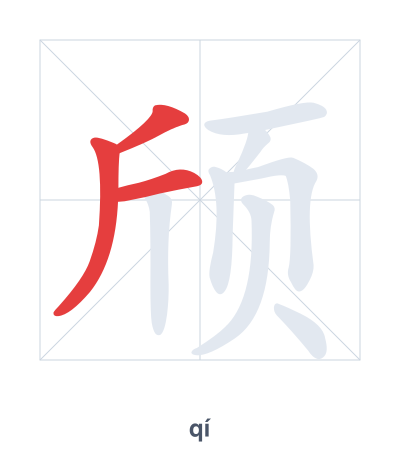
Stroke order practice for 颀 - qí

Practice Writing 颀 (qí)

Open Hanzi Writer to see the animated stroke order and practice writing 颀 with real-time feedback.

The character (qí) is written with 10 strokes. Follow the standard Chinese stroke order: top to bottom, left to right, outside before inside. The radical is one of its key components.

Practice the correct stroke order with the Hanzi Writer app to see animated stroke-by-stroke guidance with real-time feedback.

means Tall (of a person).

Character
Pinyinqí (qi)
MeaningTall (of a person)
Strokes10
Radical
Difficulty4.2/5

This character combines 页 (head) and 斤 (axe). The head component indicates the meaning relates to a person's stature, while the axe was originally a phonetic hint for the sound qí. Together they evoke a tall person whose head is as prominent as a raised axe.

💡 Memory Tip: Picture a very tall person whose head (页) is so high it's level with the blade of an axe (斤) they're holding up.

qí cháng
Tall and slender
qí wěi
Tall and sturdy
qí rán
Tall and upright

他的身材很颀长。

tā de shēn cái hěn qí cháng

His figure is very tall and slender.

他长得高大颀伟。

tā zhǎng dé gāo dà qí wěi

He is tall and well-built.

他颀然站立在门口。

tā qí rán zhàn lì zài mén kǒu

He stood tall at the doorway.

Character Pinyin Strokes Radical
(current) 10
dǐng 8
qǐng 8
hān 9
Stroke order practice for 颀 - qí

Practice Writing 颀 (qí)

Open Hanzi Writer to see the animated stroke order and practice writing 颀 with real-time feedback.

✨ Animated stroke order · Handwriting recognition · HSK-graded practice · Free to use

Frequently Asked Questions about 颀

颀 is made of two parts: the left side 斤 (axe) and the right side 页 (head/page). The 页 radical often relates to the head or neck, and 斤 here functions as a phonetic component suggesting the pronunciation qí, while the overall structure conveys the idea of a tall person with a long neck.

Characters with Radical 页

Other 10-Stroke Characters