蹀 (dié) means "to step; to pace" in Chinese. It has 16 strokes with the radical 足.
Rated 4.2/5 in difficulty (advanced).
Appears in 3+ common words including 蹀躞 (dié xiè), 蹀蹀 (dié dié), 步履 (bù lǚ).
Due to its 16 strokes, Hanzi Writer's error detection shows 蹀 requires focused practice — most learners need 10+ attempts for consistent accuracy.
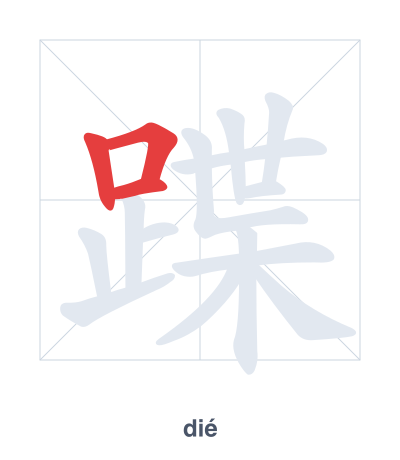
Open Hanzi Writer to see the animated stroke order and practice writing 蹀 with real-time feedback.
The character 蹀 (dié) is written with 16 strokes. Follow the standard Chinese stroke order: top to bottom, left to right, outside before inside. The radical 足 is one of its key components.
Practice the correct stroke order with the Hanzi Writer app to see animated stroke-by-stroke guidance with real-time feedback.
蹀 means to step; to pace.
蹀 is a phono-semantic compound. The radical 足 (foot) indicates the action of stepping or pacing, while the component 枼 (yè, meaning 'leaf' or 'thin piece') provides the sound and may suggest light, delicate steps like treading on leaves.
💡 Memory Tip: Imagine your foot (足) lightly stepping on a pile of dry leaves (枼), making a soft crunch as you pace.
他在房间里来回蹀躞。
tā zài fáng jiān lǐ lái huí dié xiè
He is pacing back and forth in the room.
小马在草地上蹀蹀而行。
xiǎo mǎ zài cǎo dì shàng dié dié ér xíng
The pony is trotting on the grass.
他的步履显得有些蹀躞。
tā de bù lǚ xiǎn de yǒu xiē dié xiè
His steps seem a bit hesitant.
Open Hanzi Writer to see the animated stroke order and practice writing 蹀 with real-time feedback.
✨ Animated stroke order · Handwriting recognition · HSK-graded practice · Free to use
蹀 is made of the radical 足 (foot) on the left and the phonetic component 棥 (dié) on the right. The 足 radical indicates the character relates to foot actions, while 棥 provides pronunciation but also suggests walking in a zigzag or restless manner. Together, they create the idea of stepping or pacing back and forth.