奠 (diàn) means "to establish; to offer libations" in Chinese. It has 12 strokes with the radical 大, and is HSK Level 7.
Rated 4.2/5 in difficulty (advanced).
Harder than 51% of HSK Level 7 characters.
Appears in 3+ common words including 奠定 (diàn dìng), 祭奠 (jì diàn), 奠基 (diàn jī).
Due to its 12 strokes, Hanzi Writer's error detection shows 奠 requires focused practice — most learners need 10+ attempts for consistent accuracy.
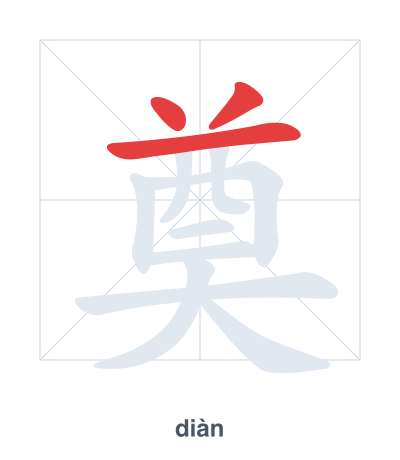
Open Hanzi Writer to see the animated stroke order and practice writing 奠 with real-time feedback.
The character 奠 (diàn) is written with 12 strokes. Follow the standard Chinese stroke order: top to bottom, left to right, outside before inside. The radical 大 is one of its key components.
Practice the correct stroke order with the Hanzi Writer app to see animated stroke-by-stroke guidance with real-time feedback.
奠 means to establish; to offer libations.
As an HSK Level 7 character, 奠 is an intermediate-level character.
The earliest form of 奠 shows a wine vessel (酉) placed on a base or stand, representing the ritual act of pouring libations to spirits or ancestors. Over time, the stand was simplified to 大 (a person or 'big'), reinforcing the idea of a person firmly establishing an offering. Thus, the character visually conveys the meaning of 'to offer libations' and 'to set down firmly' or 'establish'.
💡 Memory Tip: Picture a big person (大) planting a wine bottle (酋) on the ground like a flag, firmly establishing the spot for a sacred offering.
奠定成功的基础。
diàn dìng chéng gōng de jī chǔ
Lay the foundation for success.
他们去祭奠亲人。
tā men qù jì diàn qīn rén
They went to pay respects to their deceased relatives.
奠基仪式开始了。
diàn jī yí shì kāi shǐ le
The foundation-laying ceremony has begun.
Open Hanzi Writer to see the animated stroke order and practice writing 奠 with real-time feedback.
✨ Animated stroke order · Handwriting recognition · HSK-graded practice · Free to use
The character 奠 is composed of 酋 (a wine vessel or chief) on top and 大 (big) below. This structure originally depicted placing a vessel of wine on a large stand, symbolizing offerings to deities or ancestors, which evolved into meanings like 'to establish' and 'to offer libations.'