奘 (zàng) means "large; stout" in Chinese. It has 10 strokes with the radical 大.
Rated 4.2/5 in difficulty (advanced).
Appears in 3+ common words including 玄奘 (xuán zàng), 粗奘 (cū zàng), 健奘 (jiàn zàng).
Due to its 10 strokes, Hanzi Writer's error detection shows 奘 requires focused practice — most learners need 10+ attempts for consistent accuracy.
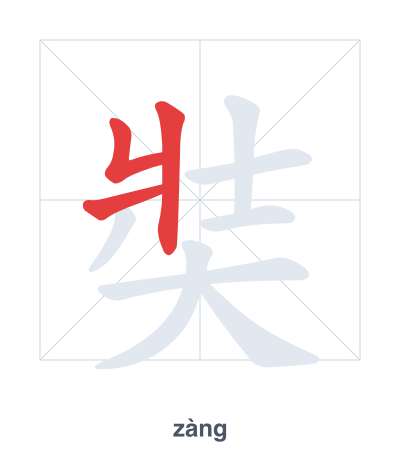
Open Hanzi Writer to see the animated stroke order and practice writing 奘 with real-time feedback.
The character 奘 (zàng) is written with 10 strokes. Follow the standard Chinese stroke order: top to bottom, left to right, outside before inside. The radical 大 is one of its key components.
Practice the correct stroke order with the Hanzi Writer app to see animated stroke-by-stroke guidance with real-time feedback.
奘 means large; stout.
奘 is a compound character formed by combining the radical 大 (dà, 'big') on top and 壮 (zhuàng, 'strong') below, visually representing something both large and powerful. The character's meaning 'large; stout' directly comes from this combination of 'big' and 'strong'.
💡 Memory Tip: Picture a huge (大) weightlifter with bulging muscles (壮) standing tall and stout.
玄奘去印度取经。
xuán zàng qù yìn dù qǔ jīng
Xuanzang went to India to obtain Buddhist scriptures.
他的胳膊很粗奘。
tā de gē bó hěn cū zàng
His arms are very thick and muscular.
他的身体很健奘。
tā de shēn tǐ hěn jiàn zàng
His body is very strong and sturdy.
Open Hanzi Writer to see the animated stroke order and practice writing 奘 with real-time feedback.
✨ Animated stroke order · Handwriting recognition · HSK-graded practice · Free to use
奘 is composed of 大 (big) on top and 壮 (strong) on the bottom. Together, these parts suggest something that is both big and strong, which directly supports the character's meaning of "large; stout".