祭 (jì) means "To sacrifice; to offer sacrifice" in Chinese. It has 11 strokes with the radical 示, and is HSK Level 7.
Rated 4.2/5 in difficulty (advanced).
Harder than 76% of HSK Level 7 characters.
Appears in 3+ common words including 祭祀 (jì sì), 祭品 (jì pǐn), 祭奠 (jì diàn).
Due to its 11 strokes, Hanzi Writer's error detection shows 祭 requires focused practice — most learners need 10+ attempts for consistent accuracy.
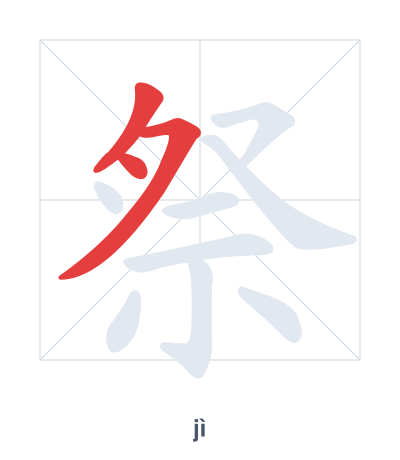
Open Hanzi Writer to see the animated stroke order and practice writing 祭 with real-time feedback.
The character 祭 (jì) is written with 11 strokes. Follow the standard Chinese stroke order: top to bottom, left to right, outside before inside. The radical 示 is one of its key components.
Practice the correct stroke order with the Hanzi Writer app to see animated stroke-by-stroke guidance with real-time feedback.
祭 means To sacrifice; to offer sacrifice.
As an HSK Level 7 character, 祭 is an intermediate-level character.
The character 祭 is a compound of 月 (meat), 又 (hand), and 示 (altar). In its ancient form, it depicted a hand holding a piece of meat dripping with blood or juice, placed upon an altar to show an offering to spirits or ancestors.
💡 Memory Tip: Picture a hand (又) holding a juicy piece of meat (月) over a sacred altar (示) as a sacrificial offering to the gods.
他们正在祭祀。
tā men zhèng zài jì sì
They are performing a sacrificial rite.
桌上放着祭品。
zhuō shàng fàng zhe jì pǐn
Offerings are placed on the table.
我们去祭奠先人。
wǒ men qù jì diàn xiān rén
We are going to pay respects to our ancestors.
Open Hanzi Writer to see the animated stroke order and practice writing 祭 with real-time feedback.
✨ Animated stroke order · Handwriting recognition · HSK-graded practice · Free to use
祭 is composed of 月 (meat) on the upper left, 又 (hand) on the upper right, and 示 (altar) at the bottom. Together, they suggest a hand placing meat on an altar, which represents the act of making an offering or sacrifice.