奚 (xī) means "why; how; what (classical)" in Chinese. It has 10 strokes with the radical 大.
Rated 4.2/5 in difficulty (advanced).
Appears in 3+ common words including 奚落 (xī luò), 奚琴 (xī qín), 奚为 (xī wèi).
Due to its 10 strokes, Hanzi Writer's error detection shows 奚 requires focused practice — most learners need 10+ attempts for consistent accuracy.
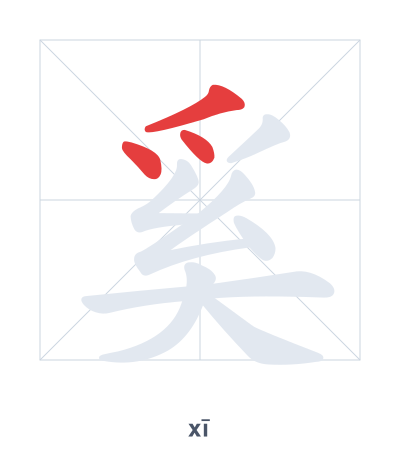
Open Hanzi Writer to see the animated stroke order and practice writing 奚 with real-time feedback.
The character 奚 (xī) is written with 10 strokes. Follow the standard Chinese stroke order: top to bottom, left to right, outside before inside. The radical 大 is one of its key components.
Practice the correct stroke order with the Hanzi Writer app to see animated stroke-by-stroke guidance with real-time feedback.
奚 means why; how; what (classical).
Originally pictographic: the ancient form showed a person (大) with a rope (系) around the neck, representing a captive slave. Over time, the meaning shifted to the interrogative 'why' or 'how' in classical Chinese, possibly from a slave's questioning of their fate.
💡 Memory Tip: Picture a big person (大) tied up with silk threads (系) asking, 'Why am I bound?'
不要奚落别人。
bú yào xī luò bié rén
Don't taunt others.
奚琴是一种乐器。
xī qín shì yī zhǒng yuè qì
The Xiqin is a type of musical instrument.
你奚为如此?
nǐ xī wèi rú cǐ
Why are you like this?
Open Hanzi Writer to see the animated stroke order and practice writing 奚 with real-time feedback.
✨ Animated stroke order · Handwriting recognition · HSK-graded practice · Free to use
奚 is composed of the radical 大 (big) at the top and 兮 (xī, a classical exclamatory particle) below. The combination suggests a strong questioning or exclamatory tone, which connects to its classical meanings of 'why', 'how', or 'what'.