蹉 (cuō) means "To slip; to miss an opportunity" in Chinese. It has 16 strokes with the radical 足.
Rated 4.2/5 in difficulty (advanced).
Appears in 3+ common words including 蹉跎 (cuō tuó), 岁月 (suì yuè), 蹉跌 (cuō diē).
Due to its 16 strokes, Hanzi Writer's error detection shows 蹉 requires focused practice — most learners need 10+ attempts for consistent accuracy.
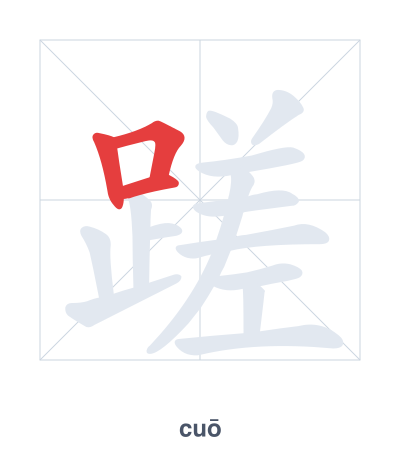
Open Hanzi Writer to see the animated stroke order and practice writing 蹉 with real-time feedback.
The character 蹉 (cuō) is written with 16 strokes. Follow the standard Chinese stroke order: top to bottom, left to right, outside before inside. The radical 足 is one of its key components.
Practice the correct stroke order with the Hanzi Writer app to see animated stroke-by-stroke guidance with real-time feedback.
蹉 means To slip; to miss an opportunity.
蹉 combines the radical 足 (foot) with 差 (difference, error). The foot making a wrong step suggests slipping or missing the mark, hence 'to slip' or 'to miss an opportunity'.
💡 Memory Tip: Imagine a foot (足) stepping on a poorly made 差 (difference) sign, causing you to slip and miss your chance.
我们不应该蹉跎时光。
wǒ men bù yīng gāi cuō tuó shí guāng
We should not waste our time.
蹉跎岁月是非常可惜的。
cuō tuó suì yuè shì fēi cháng kě xī de
It is a great pity to waste one's years.
人生难免会遇到蹉跌。
rén shēng nán miǎn huì yù dào cuō diē
It is inevitable to encounter setbacks in life.
Open Hanzi Writer to see the animated stroke order and practice writing 蹉 with real-time feedback.
✨ Animated stroke order · Handwriting recognition · HSK-graded practice · Free to use
The character 蹉 is composed of the radical 足 (foot) on the left and the phonetic component 差 (chà, meaning difference or mistake) on the right. The foot radical suggests movement or walking, while 差 implies something going wrong, together giving the idea of slipping or missing an opportunity while moving.