摧 (cuī) means "to destroy" in Chinese. It has 14 strokes with the radical 扌, and is HSK Level 7.
Rated 4.2/5 in difficulty (advanced).
Harder than 60% of HSK Level 7 characters.
Appears in 3+ common words including 摧毁 (cuī huǐ), 摧残 (cuī cán), 无坚不摧 (wú jiān bù cuī).
Due to its 14 strokes, Hanzi Writer's error detection shows 摧 requires focused practice — most learners need 10+ attempts for consistent accuracy.
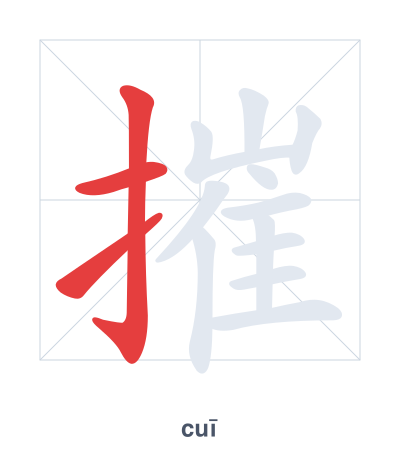
Open Hanzi Writer to see the animated stroke order and practice writing 摧 with real-time feedback.
The character 摧 (cuī) is written with 14 strokes. Follow the standard Chinese stroke order: top to bottom, left to right, outside before inside. The radical 扌 is one of its key components.
Practice the correct stroke order with the Hanzi Writer app to see animated stroke-by-stroke guidance with real-time feedback.
摧 means to destroy.
As an HSK Level 7 character, 摧 is an intermediate-level character.
The character 摧 is a phono-semantic compound: the hand radical 扌 represents the action of striking or smashing, while 崔 (cuī, meaning 'high' or 'lofty') provides the pronunciation and hints at something tall being brought down. Together, they depict the idea of forcefully destroying a towering structure.
💡 Memory Tip: Picture a hand (扌) shoving a towering mountain (崔) until it crumbles and is destroyed.
洪水摧毁了许多房屋。
hóng shuǐ cuī huǐ le xǔ duō fáng wū
The flood destroyed many houses.
这种病摧残了他的身体。
zhè zhǒng bìng cuī cán le tā de shēn tǐ
This disease ravaged his body.
我们的意志无坚不摧。
wǒ men de yì zhì wú jiān bù cuī
Our will is indestructible.
Open Hanzi Writer to see the animated stroke order and practice writing 摧 with real-time feedback.
✨ Animated stroke order · Handwriting recognition · HSK-graded practice · Free to use
The left part is the radical 扌 (hand), indicating an action. The right part is 崔 (cuī), which originally meant a high mountain. Together, the character suggests using force to break down something strong, like a mountain, giving the meaning “to destroy.”