揆 (kuí) means "To estimate or judge" in Chinese. It has 12 strokes with the radical 扌.
Rated 4.2/5 in difficulty (advanced).
Appears in 3+ common words including 揆度 (kuí dù), 阁揆 (gé kuí), 揆之 (kuí zhī).
Due to its 12 strokes, Hanzi Writer's error detection shows 揆 requires focused practice — most learners need 10+ attempts for consistent accuracy.
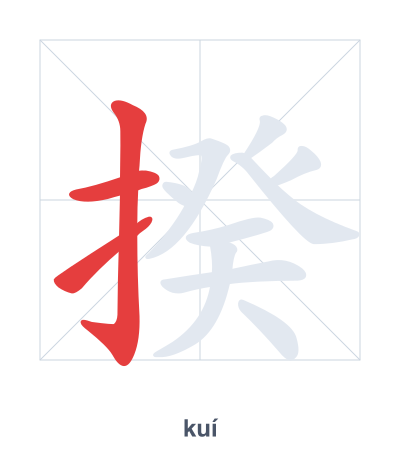
Open Hanzi Writer to see the animated stroke order and practice writing 揆 with real-time feedback.
The character 揆 (kuí) is written with 12 strokes. Follow the standard Chinese stroke order: top to bottom, left to right, outside before inside. The radical 扌 is one of its key components.
Practice the correct stroke order with the Hanzi Writer app to see animated stroke-by-stroke guidance with real-time feedback.
揆 means To estimate or judge.
揆 combines the hand radical 扌 (hand) with 癸, an ancient character originally depicting a tool for measuring or an instrument of estimation. Together, they show the hand using a gauge to assess or judge something.
💡 Memory Tip: Imagine a hand (扌) holding a strange gadget (癸) like a cosmic ruler to estimate the length of a rainbow.
揆度当下的情况。
kuí dù dāng xià de qíng kuàng
Estimate the current situation.
阁揆正在开会。
gé kuí zhèng zài kāi huì
The Premier is in a meeting.
揆之常理,这不对。
kuí zhī cháng lǐ zhè bú duì
Judging by common sense, this is wrong.
Open Hanzi Writer to see the animated stroke order and practice writing 揆 with real-time feedback.
✨ Animated stroke order · Handwriting recognition · HSK-graded practice · Free to use
揆 is made of the hand radical 扌 on the left, which hints at a physical or mental action. The right side is 癸 (guǐ), a phonetic component that also suggests the idea of measuring or ordering. Together, the character conveys using the hand or mind to gauge or judge something.