揄 (yú) means "To pull out or praise" in Chinese. It has 12 strokes with the radical 扌.
Rated 4.2/5 in difficulty (advanced).
Appears in 3+ common words including 揶揄 (yé yú), 揄扬 (yú yáng), 牵揄 (qiān yú).
Due to its 12 strokes, Hanzi Writer's error detection shows 揄 requires focused practice — most learners need 10+ attempts for consistent accuracy.
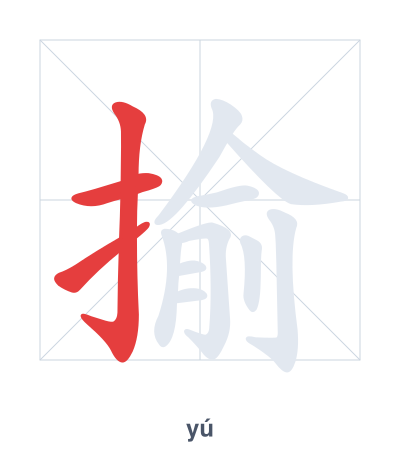
Open Hanzi Writer to see the animated stroke order and practice writing 揄 with real-time feedback.
The character 揄 (yú) is written with 12 strokes. Follow the standard Chinese stroke order: top to bottom, left to right, outside before inside. The radical 扌 is one of its key components.
Practice the correct stroke order with the Hanzi Writer app to see animated stroke-by-stroke guidance with real-time feedback.
揄 means To pull out or praise.
揄 combines the hand radical 扌 with the phonetic component 俞 (yú), which originally depicted a boat being carved or shaped. The hand suggests an action of pulling or drawing out, extending metaphorically to the meaning of 'to praise' as in drawing forth someone's virtues.
💡 Memory Tip: Picture a hand (扌) pulling a prize (俞, like a golden boat) out of a river, while everyone cheers and praises the catch.
别总是揶揄朋友。
bié zǒng shì yé yú péng yǒu
Don't always mock your friends.
老师揄扬他的优点。
lǎo shī yú yáng tā de yōu diǎn
The teacher praised his merits.
两人互相牵揄。
liǎng rén hù xiāng qiān yú
The two are pulling each other along.
Open Hanzi Writer to see the animated stroke order and practice writing 揄 with real-time feedback.
✨ Animated stroke order · Handwriting recognition · HSK-graded practice · Free to use
揄 is composed of the radical 扌 (hand) on the left and 俞 (yú) on the right. The hand radical directly connects to the actions of pulling or praising, as both can involve the hand. The right part 俞 provides the pronunciation and may hint at movement or extension.