唇 (chún) means "Lip." in Chinese. It has 10 strokes with the radical 口, and is HSK Level 7.
Rated 4.2/5 in difficulty (advanced).
Harder than 48% of HSK Level 7 characters.
Appears in 3+ common words including 嘴唇 (zuǐ chún), 唇膏 (chún gāo), 唇齿 (chún chǐ).
Due to its 10 strokes, Hanzi Writer's error detection shows 唇 requires focused practice — most learners need 10+ attempts for consistent accuracy.
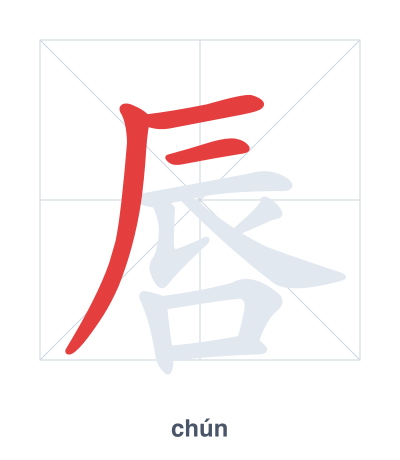
Open Hanzi Writer to see the animated stroke order and practice writing 唇 with real-time feedback.
The character 唇 (chún) is written with 10 strokes. Follow the standard Chinese stroke order: top to bottom, left to right, outside before inside. The radical 口 is one of its key components.
Practice the correct stroke order with the Hanzi Writer app to see animated stroke-by-stroke guidance with real-time feedback.
唇 means Lip..
As an HSK Level 7 character, 唇 is an intermediate-level character.
唇 is a compound character: the lower part 口 (mouth) indicates the meaning relates to the mouth, while the upper part 辰 (chén) provides the pronunciation. The original meaning refers specifically to the lip, the fleshy part around the mouth opening.
💡 Memory Tip: Imagine a mouth (口) with a bright red lipstick smear shaped like the crooked character 辰 on the upper lip.
他的嘴唇很红。
tā de zuǐ chún hěn hóng
His lips are very red.
她在涂唇膏。
tā zài tú chún gāo
She is applying lipstick.
唇齿相依,关系密切。
chún chǐ xiāng yī guān xì mì qiè
As close as lips and teeth; closely related.
Open Hanzi Writer to see the animated stroke order and practice writing 唇 with real-time feedback.
✨ Animated stroke order · Handwriting recognition · HSK-graded practice · Free to use
唇 is composed of two parts: the top part 辰 (chén) which is a phonetic component, and the bottom part 口 (kǒu) meaning mouth. Since lips are part of the mouth, the radical 口 gives a direct clue to the character's meaning.