齿 (chǐ) means "tooth" in Chinese. It has 8 strokes with the radical 齿, and is HSK Level 7.
Rated 3.4/5 in difficulty (challenging).
Harder than 14% of HSK Level 7 characters.
Appears in 3+ common words including 牙齿 (yá chǐ), 齿轮 (chǐ lún), 启齿 (qǐ chǐ).
Due to its 8 strokes, Hanzi Writer's error detection shows 齿 requires focused practice — most learners need 10+ attempts for consistent accuracy.
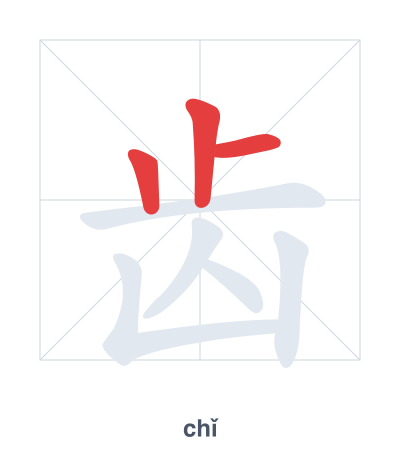
Open Hanzi Writer to see the animated stroke order and practice writing 齿 with real-time feedback.
The character 齿 (chǐ) is written with 8 strokes. Follow the standard Chinese stroke order: top to bottom, left to right, outside before inside. The radical 齿 is one of its key components.
Practice the correct stroke order with the Hanzi Writer app to see animated stroke-by-stroke guidance with real-time feedback.
齿 means tooth.
As an HSK Level 7 character, 齿 is an intermediate-level character.
The character 齿 originated as a pictograph of a mouth with teeth, with ancient forms showing a row of teeth inside an open mouth. The modern simplified version condenses this image: the top component 止 suggests the shape of upper teeth, while the bottom part resembles the jaw or mouth cavity.
💡 Memory Tip: Picture the top part 止 as two protruding front teeth and the bottom 凵 as a wide-open mouth showing them off.
他的牙齿很白。
tā de yá chǐ hěn bái
His teeth are very white.
机器里有齿轮。
jī qì lǐ yǒu chǐ lún
There are gears inside the machine.
这件事很难启齿。
zhè jiàn shì hěn nán qǐ chǐ
This matter is hard to talk about.
Open Hanzi Writer to see the animated stroke order and practice writing 齿 with real-time feedback.
✨ Animated stroke order · Handwriting recognition · HSK-graded practice · Free to use
The character 齿 is a pictograph that originally showed a mouth with teeth. Its top part 止 (zhǐ) comes from the traditional form and acts as a phonetic component, while the bottom part 凵 resembles an open mouth. Together they represent the idea of teeth inside a mouth.