膏 (gāo) means "ointment / paste / fat" in Chinese. It has 14 strokes with the radical 月, and is HSK Level 7.
Rated 4.2/5 in difficulty (advanced).
Harder than 84% of HSK Level 7 characters.
Appears in 3+ common words including 牙膏 (yá gāo), 药膏 (yào gāo), 唇膏 (chún gāo).
Due to its 14 strokes, Hanzi Writer's error detection shows 膏 requires focused practice — most learners need 10+ attempts for consistent accuracy.
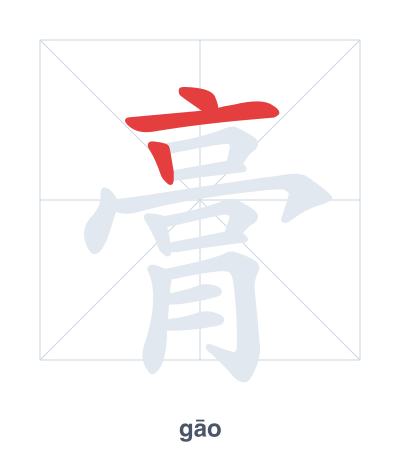
Open Hanzi Writer to see the animated stroke order and practice writing 膏 with real-time feedback.
The character 膏 (gāo) is written with 14 strokes. Follow the standard Chinese stroke order: top to bottom, left to right, outside before inside. The radical 月 is one of its key components.
Practice the correct stroke order with the Hanzi Writer app to see animated stroke-by-stroke guidance with real-time feedback.
膏 means ointment / paste / fat.
As an HSK Level 7 character, 膏 is an intermediate-level character.
The character 膏 combines the radical 月 (flesh/meat) with 高 (high/tall), originally depicting rich fat that accumulates as a thick layer on top of meat. In ancient China, 膏 referred specifically to animal fat used as ointment or grease.
💡 Memory Tip: Picture a tall tower (高) made of thick, creamy ointment sitting on a slab of meat (月).
我买了一盒牙膏。
wǒ mǎi le yī hé yá gāo
I bought a box of toothpaste.
这种药膏很好用。
zhè zhǒng yào gāo hěn hǎo yòng
This ointment is very useful.
她在涂唇膏。
tā zài tú chún gāo
She is applying lipstick.
Open Hanzi Writer to see the animated stroke order and practice writing 膏 with real-time feedback.
✨ Animated stroke order · Handwriting recognition · HSK-graded practice · Free to use
膏 is composed of 月 (the meat radical, often associated with body parts or flesh) on top and 高 (meaning tall or high) below. The 月 radical suggests something related to the body or substances like fat, while 高 may hint at the character's pronunciation. Together, they form a character for oily or paste-like substances used on the body.