捶 (chuí) means "to beat; to pound" in Chinese. It has 11 strokes with the radical 扌, and is HSK Level 7.
Rated 4.2/5 in difficulty (advanced).
Harder than 58% of HSK Level 7 characters.
Appears in 3+ common words including 捶背 (chuí bèi), 捶打 (chuí dǎ), 捶胸 (chuí xiōng).
Due to its 11 strokes, Hanzi Writer's error detection shows 捶 requires focused practice — most learners need 10+ attempts for consistent accuracy.
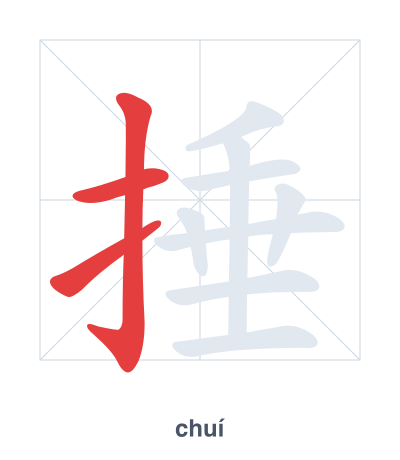
Open Hanzi Writer to see the animated stroke order and practice writing 捶 with real-time feedback.
The character 捶 (chuí) is written with 11 strokes. Follow the standard Chinese stroke order: top to bottom, left to right, outside before inside. The radical 扌 is one of its key components.
Practice the correct stroke order with the Hanzi Writer app to see animated stroke-by-stroke guidance with real-time feedback.
捶 means to beat; to pound.
As an HSK Level 7 character, 捶 is an intermediate-level character.
捶 combines the hand radical 扌 with 垂 (chuí), which originally depicted a hanging object but here serves as a phonetic and suggests a mallet-like tool. Together, the character shows a hand wielding a weight or stick to pound or beat something.
💡 Memory Tip: Picture your hand (扌) gripping a heavy hanging weight (垂) and slamming it down repeatedly to pound a nail.
我给爷爷捶背。
wǒ gěi yé yé chuí bèi
I massage my grandfather's back.
他在捶打这块铁。
tā zài chuí dǎ zhè kuài tiě
He is hammering this piece of iron.
他气得捶胸顿足。
tā qì dé chuí xiōng dùn zú
He was so angry that he beat his chest and stomped his feet.
Open Hanzi Writer to see the animated stroke order and practice writing 捶 with real-time feedback.
✨ Animated stroke order · Handwriting recognition · HSK-graded practice · Free to use
捶 is made of the hand radical 扌 on the left and 垂 on the right. The hand radical shows the action involves the hand, while 垂 gives the pronunciation and suggests a downward motion like hanging, which matches the idea of beating or pounding downward.