迟 (chí) means "late / slow" in Chinese. It has 7 strokes with the radical 辶, and is HSK Level 4.
Rated 3.5/5 in difficulty (challenging).
Harder than 37% of HSK Level 4 characters.
Appears in 3+ common words including 迟到 (chí dào), 迟早 (chí zǎo), 推迟 (tuī chí).
Due to its 7 strokes, Hanzi Writer's error detection shows 迟 requires focused practice — most learners need 10+ attempts for consistent accuracy.
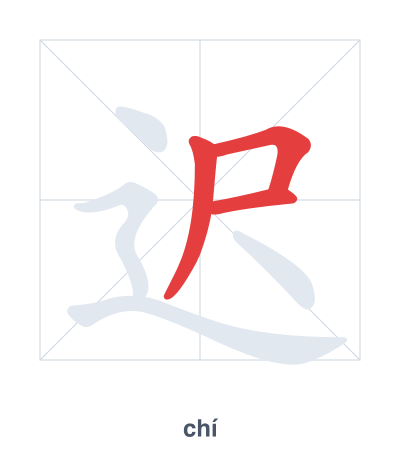
Open Hanzi Writer to see the animated stroke order and practice writing 迟 with real-time feedback.
The character 迟 (chí) is written with 7 strokes. Follow the standard Chinese stroke order: top to bottom, left to right, outside before inside. The radical 辶 is one of its key components.
Practice the correct stroke order with the Hanzi Writer app to see animated stroke-by-stroke guidance with real-time feedback.
迟 means late / slow.
As an HSK Level 4 character, 迟 is an intermediate-level character.
迟 is a phono-semantic compound where 辶 (walking radical) indicates movement, and 尺 (ruler/measure) provides the pronunciation. It originally meant to go slowly or be delayed, evoking the image of measured, unhurried steps.
💡 Memory Tip: Picture a person walking (辶) so slowly they use a ruler (尺) to measure each tiny step, making them late for everything.
对不起,我迟到了。
duì bù qǐ wǒ chí dào le
Sorry, I'm late.
他迟早会明白的。
tā chí zǎo huì míng bái de
He will understand sooner or later.
会议推迟到明天了。
huì yì tuī chí dào míng tiān le
The meeting has been postponed until tomorrow.
Open Hanzi Writer to see the animated stroke order and practice writing 迟 with real-time feedback.
✨ Animated stroke order · Handwriting recognition · HSK-graded practice · Free to use
迟 is made of the radical 辶 (walk) on the left and 尺 (chǐ, a unit of length) on the right. The walking radical suggests movement, and 尺 hints at measuring distance or time — together they convey the idea of moving slowly or being behind schedule.