篪 (chí) means "ancient bamboo flute with eight holes" in Chinese. It has 16 strokes with the radical 竹.
Rated 4.2/5 in difficulty (advanced).
Appears in 3+ common words including 吹篪 (chuī chí), 篪声 (chí shēng), 埙篪 (xūn chí).
Due to its 16 strokes, Hanzi Writer's error detection shows 篪 requires focused practice — most learners need 10+ attempts for consistent accuracy.
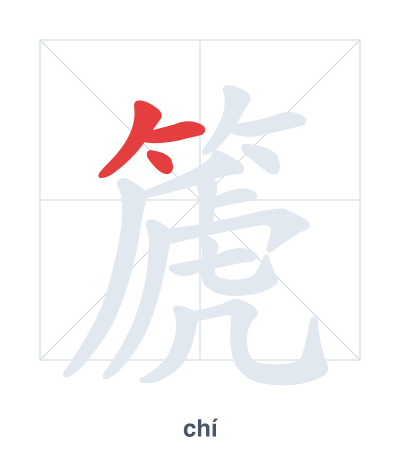
Open Hanzi Writer to see the animated stroke order and practice writing 篪 with real-time feedback.
The character 篪 (chí) is written with 16 strokes. Follow the standard Chinese stroke order: top to bottom, left to right, outside before inside. The radical 竹 is one of its key components.
Practice the correct stroke order with the Hanzi Writer app to see animated stroke-by-stroke guidance with real-time feedback.
篪 means ancient bamboo flute with eight holes.
篪 is a compound character with the radical 竹 (bamboo) indicating the material, and the phonetic component 虒 (sì) suggesting the sound. The character depicts a bamboo flute, an ancient instrument with eight holes, where bamboo signifies the material and the top part hints at the flute's shape or mouthpiece.
💡 Memory Tip: Imagine a bamboo (竹) flute with eight holes, and the right side 虒 looks like a little monster blowing into it to produce a cheerful tune.
谁在吹篪?
shuí zài chuī chí
Who is playing the bamboo flute?
篪声非常悠扬。
chí shēng fēi cháng yōu yáng
The sound of the flute is very melodious.
埙篪是古代乐器。
xūn chí shì gǔ dài yuè qì
The xun and chi are ancient musical instruments.
Open Hanzi Writer to see the animated stroke order and practice writing 篪 with real-time feedback.
✨ Animated stroke order · Handwriting recognition · HSK-graded practice · Free to use
篪 is composed of the radical 竹 (bamboo) on top, indicating the flute is made of bamboo. The bottom part 虒 does not directly relate to the meaning, but the whole character represents an ancient eight-hole bamboo flute.